

Remember when Google tried to take on Facebook? If you’ve ever typed “Google Plus” into a search bar and wondered what it was — or where it went — you’re not alone. Despite being officially shut down years ago, Google Plus still generates thousands of searches every month. Some people are curious about its history, others are chasing down archived content, and a surprising number are students looking for unblocked tools and games. Whatever brought you here, this guide covers everything you need to know about Google Plus, why it mattered, why it failed, and what’s worth exploring today.
What Was Google Plus and Why It Was Launched
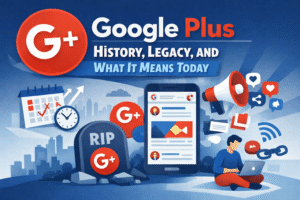
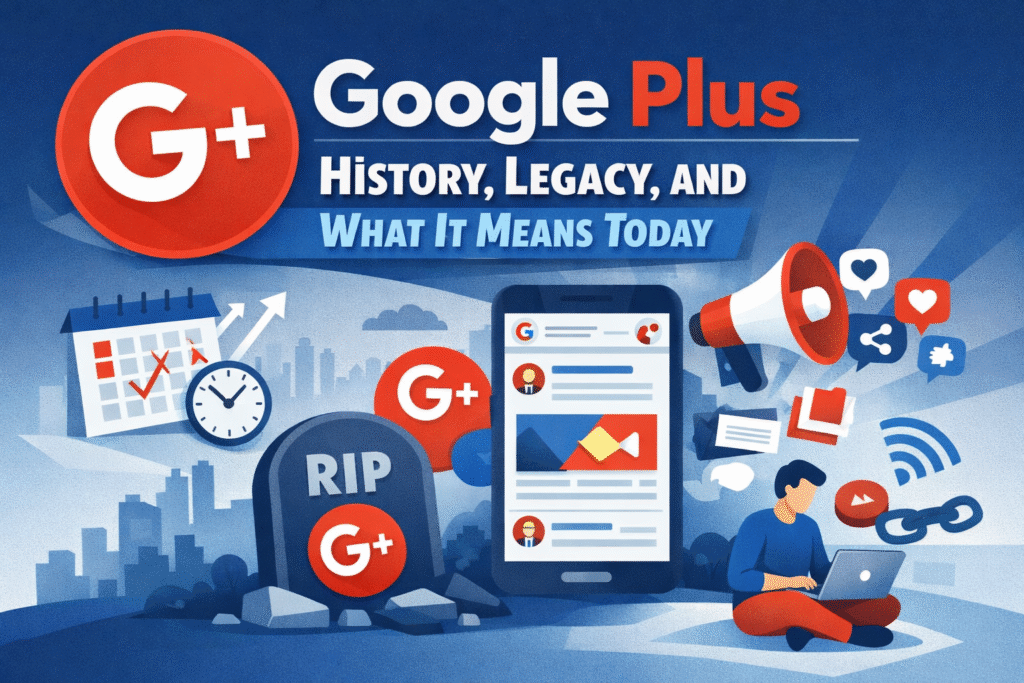
Launched in June 2011, Google Plus (stylized as Google+) was Google’s ambitious attempt to build a fully integrated social networking platform. The goal was simple on paper but massive in scope: take on Facebook and Twitter by weaving social features directly into the Google ecosystem.
At the time, Google and Google Plus were being positioned as inseparable. Google wanted every user’s online identity — their searches, emails, YouTube comments, and social interactions — to flow through a single connected profile. Sign into Gmail? You had a Google Plus profile. Leave a YouTube comment? It was tied to Google Plus. Write a review on Google Maps? Same deal.
The idea wasn’t entirely wrong. Google had hundreds of millions of users spread across its products, and connecting all of them into one social layer made strategic sense. The problem, as we’ll see, was execution and timing. Facebook already had a billion users and deeply ingrained habits. Google Plus was entering the game late and trying to change the rules — which rarely works.
Key Features That Made Google Plus Different
Despite its eventual fate, Google Plus had some genuinely innovative features that earned it a loyal (if small) user base.
Circles were the platform’s signature concept. Instead of lumping all your connections into one generic “friends” list, Circles let you organize people into groups — Family, Colleagues, Close Friends, Acquaintances — and share content selectively. It was a smarter approach to online privacy than Facebook offered at the time, and many users appreciated the control.
Communities functioned like Facebook Groups or Reddit subreddits. Users could find and join interest-based groups on topics ranging from photography and science to gaming and cooking. Some of these communities were genuinely active and well-moderated, creating niches where enthusiasts thrived.
Hangouts was Google’s video calling feature, built natively into the platform. Before Zoom became a household name, Google Hangouts was one of the more polished group video chat tools available — and it was free.
The deep integration with Gmail, Google Drive, and Google Photos also made the platform attractive to people already living inside the Google ecosystem. Photos you uploaded were automatically backed up, and sharing documents felt natural.
For users who valued privacy controls, meaningful discussion threads, and minimal advertising noise, Google Plus offered a different social experience. It just never reached the critical mass needed to sustain itself.
Why Google Plus Was Shut Down
By the mid-2010s, it was clear that Google Plus wasn’t growing the way Google had hoped. Most users who created accounts — often because they were prompted to when setting up a Gmail or YouTube account — never really engaged with the platform.
Two major forces accelerated its decline. First, low organic adoption: people already had Facebook, Twitter, and LinkedIn habits. Switching platforms requires a compelling reason, and Google Plus never delivered one at scale. Second, and more critically, security vulnerabilities: in 2018, Google disclosed a significant data breach that had exposed the private data of hundreds of thousands of users. The company had known about the bug for months before going public, which damaged trust considerably.
Google announced the shutdown of Google Plus for consumers in October 2018, with the platform officially closing in April 2019. The enterprise version, Google+ for G Suite (later Currents), limped along until 2023 before being retired as well.
Competitors like Facebook, Twitter, and the rapidly growing Instagram had fragmented the social media landscape in ways Google couldn’t overcome with a late entry, no matter how well-integrated the product was.
What People Search Today — Modern Context
So why are people still searching for Google Plus in 2024 and beyond? The reasons are more varied than you’d expect.
Some users are researching digital history — students, marketers, and tech enthusiasts curious about one of the most notable failed product launches of the last two decades.
Others search unblocked Google Plus because they’re in environments — schools, offices, or restricted networks — where social platforms are blocked, and they’re wondering if Google Plus might still be accessible or if archived versions exist. The answer is mostly no; the platform is gone, but its legacy lingers in search intent.
Then there’s unblocked games Google Plus, a term that reveals an interesting crossover. Some browser game portals and nostalgic gaming communities have borrowed the “Google Plus” name or branding informally. Students searching for unblocked games often stumble across these references, creating a persistent search trail even though the original platform has nothing to do with gaming.
In restricted environments, search terms like unblocked Google Plus and unblocked games Google Plus reflect a broader pattern: users looking for accessible, unrestricted content using the trusted “Google” brand name as an anchor.
Useful Tools Related to the Google Ecosystem
Just because Google Plus is gone doesn’t mean the Google ecosystem has stood still. In fact, it’s grown significantly — and one of the most exciting modern additions is AI-powered productivity tooling.
Plus AI for Google Slides
One of the most useful tools in the current Google workspace landscape is Plus AI for Google Slides. This is a third-party AI add-on (not a native Google product) that integrates directly with Google Slides to help users create, edit, and polish presentations using artificial intelligence.
With Plus AI for Google Slides, you can:
- Generate full slide decks from a text prompt. Describe your topic, and the AI builds out a structured presentation with slides, talking points, and formatting.
- Rewrite or refine existing slides. Paste in rough content and let the AI clean up the language, improve flow, or adjust tone for your audience.
- Summarize and condense long documents into presentation-ready bullet points automatically.
It’s particularly useful for business professionals, educators, and students who need to turn ideas into polished presentations quickly. If you regularly work inside Google Workspace, Plus AI for Google Slides is worth exploring as a productivity multiplier.
Alternatives to Google Plus
If what you’re looking for is the spirit of Google Plus — a community-driven, interest-based social space — several modern platforms fill that gap well.
Reddit is the closest equivalent to Google Plus Communities. Subreddits function just like the old Google Plus interest groups, with active moderation and niche communities on virtually every topic.
Discord has become the go-to platform for real-time community building, especially for gaming, creative projects, and professional networks. Its server structure mirrors the Circles concept in a more dynamic way.
LinkedIn has evolved significantly and now supports creator tools, newsletters, and community engagement that rival older social networks.
For collaborative work within the Google ecosystem specifically, Google Spaces (within Google Chat) offers some of the group communication features that Google Plus once aimed to deliver.
Conclusion
Google Plus was one of the most ambitious — and ultimately most instructive — product experiments in tech history. It had real innovations, a passionate niche community, and the full weight of Google’s ecosystem behind it. But competing against entrenched social habits proved harder than even Google could overcome.
Today, the legacy of Google Plus lives on in the design philosophy of modern tools: privacy controls, interest-based communities, and integrated collaboration. Whether you’re researching its history, trying to recover old content, exploring what “unblocked Google Plus” means in today’s context, or discovering modern tools like Plus AI for Google Slides, the story of Google+ offers lessons that still apply.
Your next step? Explore the modern alternatives — Reddit for communities, Discord for real-time connection, and Plus AI for Google Slides if you want AI-powered productivity inside the Google ecosystem you already use every day.
FAQs
1. Is Google Plus still available?
No. Google Plus for consumers shut down in April 2019 following low user engagement and a significant data breach. The enterprise version was retired in 2023. The platform is no longer accessible.
2. What does “unblocked games Google Plus” mean?
This term typically refers to browser-based games accessible on networks where social platforms are restricted. Some game portals informally use “Google Plus” in their naming or SEO — but these have no official connection to the original Google+ platform.
3. Can I access old Google Plus content?
Some archived content may be available via the Wayback Machine (web.archive.org), which periodically crawled and stored snapshots of public Google Plus profiles and communities before shutdown. Google also allowed users to download their data through Google Takeout before the platform closed.
4. How is Plus AI for Google Slides used today?
Plus AI for Google Slides is used as a productivity add-on within Google Workspace. Users install it via the Google Workspace Marketplace, then access it inside Google Slides to generate presentations from prompts, improve existing content, or automate slide formatting. It’s especially popular among teams that create a high volume of presentations.