

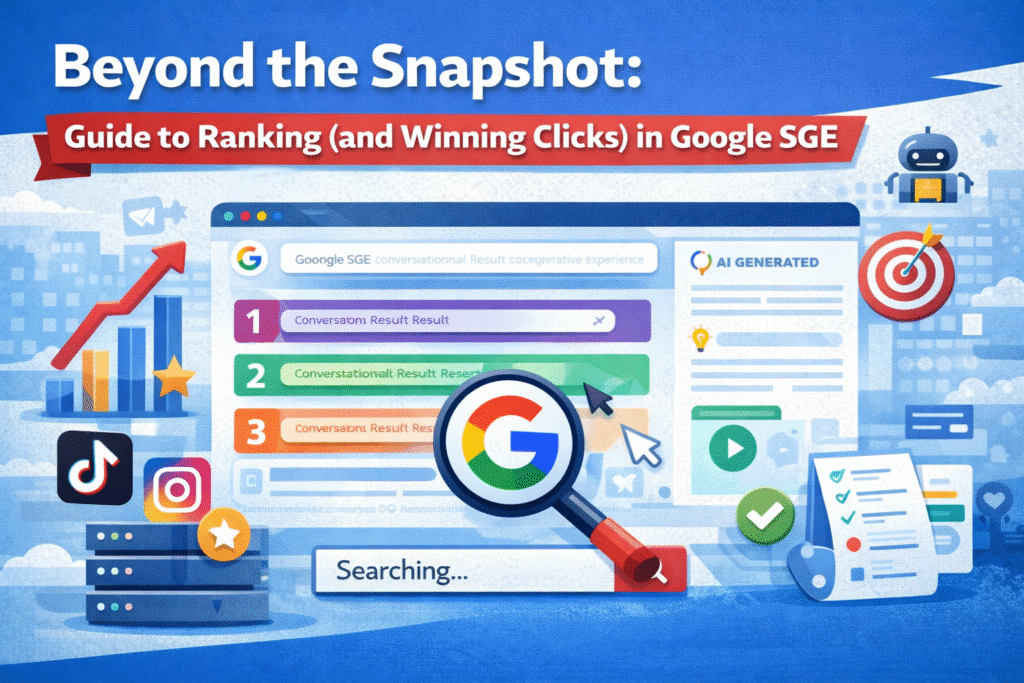
To rank in Google SGE in 2026, websites must focus on Generative Engine Optimization (GEO). Key strategies include providing “Atomic Answers” (direct 50-word summaries), utilizing FAQ and Author Schema to boost E-E-A-T, and creating “Information Gain” through original data. To maintain traffic, content should answer the “What” in the snippet while reserving the “How” for the click-through.
The 2026 Reality: Why Traditional SEO is No Longer Enough
For two decades, SEO was about winning the #1 blue link. In 2026, that link is often buried under a massive, AI-generated snapshot.
Google’s SGE doesn’t just crawl for keywords; it crawls for answers. If your content doesn’t provide a clear, extractable answer within the first 200 words, you aren’t just losing the top spot—you’re becoming invisible. To win in this “Zero-Click” era, your blog must act as a primary data source for Gemini while remaining compelling enough to entice a human to click “Read More.”
The Q-A-V Framework: Your Blueprint for SGE Dominance
To ensure your content is chosen as a cited source in the SGE carousel, use the Q-A-V Framework. This structure aligns with how Large Language Models (LLMs) process and retrieve information.
Q – Question-Led Headers
SGE is built on natural language prompts. Users no longer type “SGE ranking factors”; they ask, “How do I get my website featured in the AI overview?”
- The Strategy: Use $H_2$ and $H_3$ headers that mirror these conversational questions.
- The Goal: Trigger a direct “intent match” between the user’s prompt and your heading.
A – Atomic Answers
Directly beneath every question-led header, provide an “Atomic Answer.”
- The Format: A 40–60 word paragraph that directly answers the heading without fluff.
- The Goal: This serves as your “application” for the SGE snapshot. Google prefers these concise blocks because they are easy to summarize and cite.
V – Verified Authority (The E-E-A-T Signal)
AI can summarize facts, but it cannot replicate human experience.
- The Strategy: Use “I” and “We” statements. Include original data, screenshots of your own experiments, or a “Pro-Tip” box based on your professional history.
- The Goal: Google’s quality algorithms heavily weight Experience. If you show how you did something, you earn a trust signal that AI-generated content cannot mimic.

The Multimodal Edge: Optimizing for the SGE Carousel
In 2026, SGE is multimodal. Google doesn’t just “read” your blog; it “sees” your images and “watches” your videos to build a complete answer.
- Vision Strategy: SGE carousels often feature images alongside text. Use Descriptive Alt-Text (e.g., “Infographic showing 2026 SGE ranking factors”) and Contextual Captions to help the AI understand why your visual is the best match.
- Video Key Moments: Embed short (60-second) videos. Use YouTube Chapters (timestamps) in your description. SGE often pulls these “Key Moments” directly into the search result, allowing users to jump to the exact answer they need.
The “Click-Gap” Strategy: Driving Actual Traffic
The biggest threat of SGE is the “Zero-Click Search.” To combat this, we use the Click-Gap Strategy.
The “What vs. How” Rule
- Give the “What” for free: In your Atomic Answer, give the AI exactly what it needs to define the concept. This ensures you get the citation and brand visibility.
- Tease the “How” for the click: Use phrases like, “While the definition is simple, the execution requires a 5-step framework we’ve tested on 100+ sites. Below, we break down the specific settings you need…”
Proprietary Data as a Magnet
AI models can summarize public knowledge, but they cannot invent your unique data.
- The Move: Include a “Original Research” section. For example: “In our 2026 study of 500 AI Overviews, we found that 70% of cited sources used FAQ Schema.” Because this info exists only on your site, Google must cite you, and users will click to see the full data set.
Technical Checklist for SGE Success
Before you hit publish, ensure these technical hooks are in place:
| Feature | Requirement | SGE Benefit |
| FAQ Schema | JSON-LD Structured Data | Direct ingestion of Q&A for the snapshot. |
| Author Schema | Verified social links/Bio | Proof of “Experience” (E-E-A-T). |
| Site Speed | Under 2.0s Load Time | Faster “retrieval” for real-time AI generation. |
| Internal Links | Topic Cluster Model | Establishes “Topical Authority” in the niche. |
Final Thoughts: Adapt or Disappear
Ranking for SGE isn’t about gaming an algorithm; it’s about being the most useful, verified, and clear source of information on the web. By using the Q-A-V framework and focusing on the Click-Gap, you won’t just survive the AI revolution—you’ll lead it.
The search landscape is changing fast, but your growth doesn’t have to stall. If you’re ready to transform your content strategy and claim your spot in the AI carousels, partner with the experts at AlphaTech to future-proof your digital presence today.
FAQ’s
What is Google SGE?
Google SGE (Search Generative Experience) is an AI-powered search feature that uses large language models (like Gemini) to provide synthesized answers directly at the top of search results. Unlike traditional search, SGE compiles information from multiple sources into a single, conversational response with citations.
Does SGE mean the end of SEO?
No, SGE represents an evolution of SEO into Generative Engine Optimization (GEO). While “Zero-Click” searches may increase for simple factual queries, SGE creates new opportunities for high-authority sites to be featured as primary citations in the AI-generated snapshot, driving highly qualified traffic.
How long should an “Atomic Answer” be for SGE?
An ideal Atomic Answer should be between 40 and 60 words. It should be placed directly under a heading and provide a concise, factual summary of the topic. This allows Google’s AI to easily extract the text for use in its generative response.
How do I track SGE rankings in Search Console?
Currently, Google Search Console does not provide a separate filter for SGE traffic. However, you can monitor “Impressions” and “Average Position” for long-tail, conversational queries. An increase in impressions with a stable or slightly lower CTR often indicates your content is being used in an SGE snapshot.
Is Schema markup required for SGE?
While not strictly required, Schema markup (specifically FAQ, How-To, and Product) acts as a roadmap for AI models. It helps the generative engine verify the structure of your data, making it significantly more likely that your site will be chosen as a cited source in the SGE carousel.