

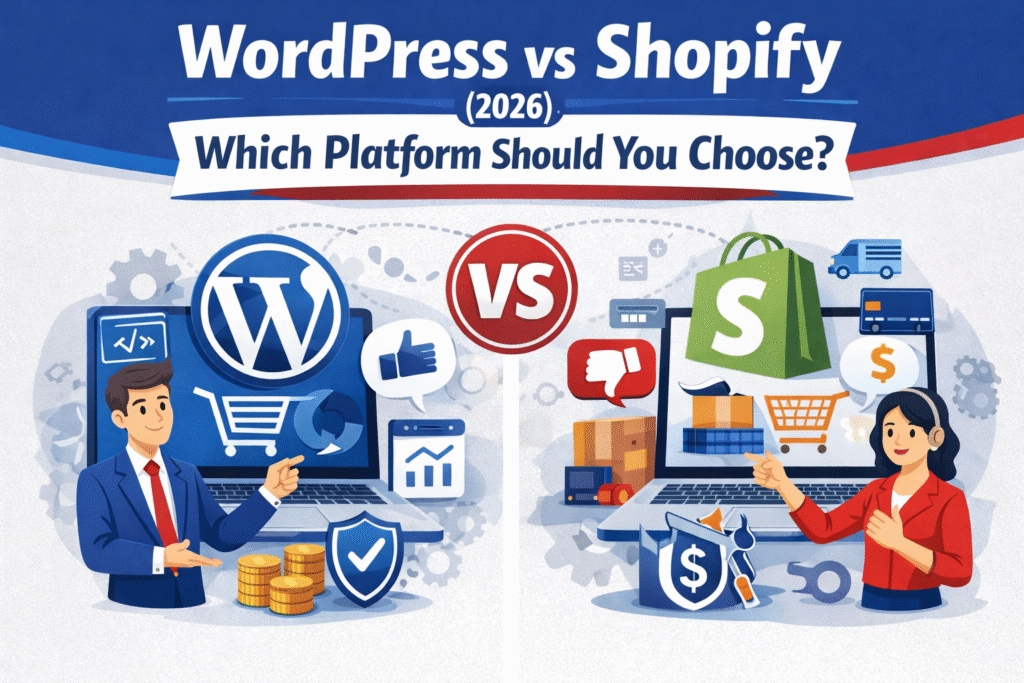
The honest, no-fluff comparison that covers pricing, SEO, ease of use, and everything in between — so you can make the right decision for your online business.
Shopify is the better pick if you want a fast, hassle-free online store with everything built in. WordPress (with WooCommerce) is the better pick if you need maximum customization, powerful SEO, and full control over your website. Neither is universally “best” — it depends entirely on your goals, budget, and technical comfort level.
Every day, thousands of entrepreneurs face the same question: WordPress vs Shopify — which platform should I use to build my online store or website?
It’s one of the most searched comparisons on the internet for good reason. Both platforms power millions of websites. Both can help you sell products online. But they work in completely different ways, and choosing the wrong one can cost you time, money, and serious ranking headaches down the road.
In this guide, we’ve analyzed the top-ranking competitor articles, studied real user reviews, and broken down every major factor — pricing, ease of use, ecommerce features, SEO capabilities, customization, scalability, and more — so you can make a truly informed decision.
What Are WordPress and Shopify?
Before comparing them feature-by-feature, let’s understand what each platform actually is — because they were built for very different purposes.
Shopify
All-in-one ecommerce platform
- Dedicated online store builder (SaaS)
- Fully hosted — no server management
- Built-in payments, inventory, shipping
- Monthly subscription model
- Focused 100% on selling products
- Beginner-friendly dashboard
WordPress
Open-source content management system
- Flexible CMS powering 43%+ of the web
- Self-hosted — you own everything
- Ecommerce via WooCommerce plugin
- Free core software
- Can build any type of website
- Requires more technical setup
Think of Shopify like renting a premium, fully equipped store in a modern mall — everything is taken care of for a monthly fee. WordPress, on the other hand, is like owning land and building your own store from scratch — you have total freedom but total responsibility too.

WordPress vs Shopify: Quick Comparison Table
Here’s a fast, side-by-side overview of the most important factors:
| Feature | Shopify | WordPress + WooCommerce |
|---|---|---|
| Ease of Use | Winner Beginner-friendly, guided setup | Steeper learning curve, more steps |
| Starting Cost | From $39/month (hosted) | Winner As low as $10–20/month |
| Ecommerce Features | Winner Built-in, all-in-one | Requires WooCommerce plugin |
| SEO Capability | Good for beginners | Winner Full control, advanced SEO |
| Customization | Good, but within limits | Winner Unlimited customization |
| Themes Available | 24 free + ~1,000 paid | Winner 14,000+ themes |
| Plugins/Apps | 8,000+ apps in App Store | Winner 60,000+ plugins |
| Hosting | Winner Included in plan | You pay separately |
| Security | Winner Fully managed, automatic | Your responsibility (plugins help) |
| Blogging / Content | Basic blog built in | Winner Best-in-class CMS |
| Transaction Fees | 0.5%–2% (if not using Shopify Payments) | Winner No platform transaction fees |
| Data Ownership | Limited (platform lock-in risk) | Winner You own everything |
| Best For | Beginners, pure ecommerce | Content-heavy sites, full control |
Ease of Use: Which Platform Is Easier for Beginners?
Shopify: Ready to Sell in Minutes
Shopify was designed with one purpose: get you selling online as fast as possible. When you sign up, you’re immediately guided through a step-by-step walkthrough — add your products, set up payments, configure shipping, and launch. No hosting to worry about, no SSL certificates to configure, no server settings to fiddle with.
The dashboard is clean and focused entirely on commerce. Every menu item — Orders, Products, Customers, Analytics — is exactly where you expect it to be. Even if you’ve never built a website before, you can have a live Shopify store within a couple of hours.
Shopify’s AI tool “Sidekick” can help you write product descriptions, generate metadata, and give personalized SEO recommendations — all from the dashboard, with no extra apps required.
WordPress: Powerful But Has a Learning Curve
WordPress, by contrast, doesn’t come with ecommerce features out of the box. To build an online store, you first need to: choose a hosting provider, install WordPress, pick and install a theme, install WooCommerce, configure your payment gateways, set up shipping, and then secure your site.
That’s a lot more steps. But here’s the thing — once you’ve climbed that learning curve, WordPress gives you far more flexibility and long-term power than Shopify can ever offer.
Verdict: Shopify wins for ease of use, especially for complete beginners. WordPress is manageable for users with some technical confidence or those who have a developer to help.
Pricing & True Cost: What Will You Actually Pay?
In the WordPress vs Shopify comparison, pricing works differently. Shopify offers fixed plans from $5 to $2,300+ per month, plus extra costs for apps, themes, and transaction fees. WordPress is free but requires hosting, domain, and plugins. Over time, WordPress is usually cheaper, while Shopify is more convenient.
Ecommerce Features: Which Platform Sells Better?
Shopify’s Built-In Commerce Powerhouse
Shopify was built from day one to be an ecommerce engine. Every feature — inventory management, order tracking, abandoned cart recovery, discount codes, multi-channel selling (Instagram, TikTok, Amazon, eBay), and Shopify Payments — is integrated natively into the platform.
You don’t need to install separate apps for core selling functions. Shipping label printing, real-time carrier rates, POS (point of sale) for physical stores, and even built-in analytics are all baked in. This makes Shopify especially powerful for businesses that want to scale without managing technical complexity.
WordPress + WooCommerce: Flexible But Modular
WordPress doesn’t have ecommerce built in — you add it by installing WooCommerce, the world’s most popular ecommerce plugin. Once installed, WooCommerce is genuinely powerful: you can sell unlimited products, choose from over 140 payment gateways, set up complex shipping rules, and avoid the platform transaction fees that Shopify charges.
The major difference is that advanced features on WooCommerce often require separate extensions — subscriptions, wishlists, advanced analytics, and so on. Each of these has its own cost and maintenance overhead.
Shopify Ecommerce Pros
- Everything built-in, zero setup friction
- Shopify Payments = no extra transaction fees
- Native multi-channel selling
- Automatic inventory tracking
- POS system for physical retail
- 8,000+ apps for extended functionality
Shopify Ecommerce Cons
- Transaction fees if not using Shopify Payments
- Forced URL structure (/products/, /collections/)
- Apps can add $50–150/month to costs
- Less flexible for unique store setups
WordPress Ecommerce Pros
- No platform transaction fees — ever
- 140+ payment gateway options
- Full control over checkout experience
- 60,000+ plugins for any feature imaginable
- Better for content + commerce combo sites
WordPress Ecommerce Cons
- Requires installing and configuring WooCommerce
- Updates can break plugin compatibility
- Hosting & security are your responsibility
- Premium features cost extra per plugin
SEO Capabilities: Which Platform Ranks Better on Google?
If you’re serious about organic traffic, this section is critical. The platform you choose will directly impact how well you can optimize your site for search engines.
WordPress SEO: The Clear Leader for Advanced Optimization
WordPress gives you total control over every SEO element. You can define custom URL structures (no forced subfolder paths), create complex content hierarchies for topical authority, and use industry-leading SEO plugins like Yoast SEO or RankMath to manage meta titles, descriptions, schema markup, XML sitemaps, canonical tags, and internal linking.
The blogging capabilities of WordPress are also unmatched — and content is still the backbone of any strong SEO strategy. Creating a deep library of SEO-optimized blog posts, product guides, FAQs, and how-to articles is significantly easier on WordPress than on any other platform.
Shopify SEO: Good for Beginners, Limited for Experts
Shopify’s SEO tools are solid for beginners — it automatically generates sitemaps, handles canonical URLs, and even uses AI to suggest meta descriptions and alt text. It’s beginner-friendly and handles the basics well out of the box.
However, there are clear limitations. Shopify enforces rigid URL structures: all product pages must live under /products/ and all collections under /collections/ — and you cannot change this. Advanced schema markup requires third-party apps. Shopify’s built-in blog is significantly less capable than WordPress for content marketing.
SEO Verdict: WordPress wins — and it’s not particularly close. For any business that takes organic search seriously, WordPress gives you the tools and flexibility to dominate Google. Shopify is acceptable for beginners but has a ceiling that serious SEOs will quickly hit.

Customization & Design: Themes, Templates, and Control
WordPress: Virtually Unlimited Design Freedom
WordPress is open-source, which means you can edit every line of code. With over 14,000 themes in the official directory (plus premium marketplaces offering thousands more), you have far more starting points than Shopify. The Gutenberg block editor lets you create custom layouts without coding. If you want something truly unique, developers can write custom PHP, CSS, JavaScript, or use hooks and filters to modify any part of the site.
Shopify: Beautiful But Bounded
Shopify’s themes are professionally designed, mobile-responsive, and generally well-optimized right out of the box. With around 24 free themes and about 1,000 paid options ($100–$500 each), you have solid choices — but significantly fewer than WordPress. Shopify’s Liquid templating language allows customization, but there are parts of the platform’s code you simply cannot touch, which limits truly bespoke designs.
Scalability & Performance
Both platforms can scale to large businesses — but in very different ways.
Shopify handles scalability automatically. It uses a global Content Delivery Network (CDN), manages traffic spikes, and handles all the infrastructure for you. Most Shopify themes are fast by default and require little optimization to pass speed benchmarks like Google PageSpeed Insights.
WordPress gives you a higher performance ceiling — if configured correctly. With the right managed hosting provider (like Kinsta or WP Engine), a good caching strategy, and image optimization, a WordPress site can be extremely fast. However, a poorly configured WordPress site on cheap shared hosting can be slow and unreliable. The ceiling is higher, but so is the floor of required knowledge.
Verdict: Shopify wins for effortless scalability. WordPress wins for maximum scalability potential in the hands of someone technical.
Security & Maintenance
Shopify takes care of all security — SSL certificates, PCI compliance for payment processing, automatic updates, and round-the-clock monitoring. You never have to think about it. Shopify also provides 24/7 customer support via live chat (and phone for Plus plans).
WordPress requires you to manage your own security. You’ll need to install a security plugin (like Wordfence or Sucuri), keep WordPress, themes, and plugins regularly updated, set up backups, and monitor for vulnerabilities. While this sounds daunting, managed WordPress hosts often handle most of this for you — at a higher price point.
Verdict: Shopify wins for security and maintenance simplicity. WordPress can be made equally secure, but it requires active effort.
Who Should Choose WordPress? Who Should Choose Shopify?
Let’s cut through the noise with clear, practical guidance.
Choose Shopify If You Are…
- A complete beginner to web building
- Launching a pure ecommerce store quickly
- Don’t want to manage hosting or security
- Selling physical products at volume
- Need multi-channel selling (social, marketplaces)
- Running a dropshipping business
- Want predictable monthly costs
Choose WordPress If You Are…
- Building a content-heavy site with a store
- Serious about long-term SEO and blogging
- Need full customization freedom
- Technically capable (or have a developer)
- Want to avoid platform lock-in
- Looking for the lowest total cost of ownership
- Building a digital products store
You don’t have to pick strictly one or the other. Many businesses run WordPress as their main website and blog (for SEO power), and embed Shopify’s buy buttons for the actual checkout process — getting the best of both worlds.
Final Verdict: WordPress vs Shopify
Here’s the definitive breakdown, category by category:
Ease of Use: Shopify wins. Get your store live within hours, no technical skills required. WordPress has more steps and a steeper learning curve.
Cost (Long-Term): WordPress wins. With no platform transaction fees and flexible hosting options, WordPress is typically $1,800+ cheaper over three years for the same store.
Ecommerce Out-of-Box: Shopify wins. Built-in payments, inventory, shipping, and POS — no plugins needed for core selling.
SEO & Content Marketing: WordPress wins — decisively. Full URL control, superior blogging, advanced SEO plugins, and the ability to build topical authority that Shopify simply can’t match.
Customization: WordPress wins. With 60,000+ plugins, 14,000+ themes, and open-source access to every line of code, no platform comes close.
Security & Maintenance: Shopify wins. Fully managed security, automatic updates, and 24/7 support mean zero infrastructure headaches.
Overall Winner?It depends on you. Shopify is the best choice for most beginners and pure ecommerce businesses. WordPress is the best choice for anyone who values SEO, content, customization, and long-term cost savings over convenience.
Related Comparisons You Might Find Useful
Now that you understand the WordPress vs Shopify debate, here are some closely related topics that often come up in the decision-making process:
- WooCommerce vs Shopify — A deeper dive specifically into how Shopify’s native commerce compares with WooCommerce as a dedicated ecommerce plugin
- Shopify vs WordPress for dropshipping — Shopify tends to win here thanks to dedicated dropshipping apps like DSers and AutoDS
- WordPress vs Shopify for bloggers who want to sell — WordPress wins easily; Shopify’s blog is limited compared to WordPress’s native CMS
- Shopify vs Wix vs WordPress — How all three website builders and CMS platforms stack up for different use cases
- Best ecommerce platform for small business 2025 — Shopify for pure selling; WordPress + WooCommerce for content-commerce hybrids

Conclusion:
The WordPress vs Shopify debate doesn’t have a single right answer. Both are genuinely excellent platforms used by millions of successful businesses worldwide.
If you want to start selling online today with zero technical hassle, Shopify is the platform for you. Its all-in-one approach, built-in ecommerce tools, and beginner-friendly setup mean you can focus 100% on running your business — not managing technology.
If you want long-term SEO power, complete ownership of your website, unlimited customization, and the potential for lower costs — WordPress with WooCommerce is your platform. Yes, it takes more work to set up. But for serious content marketers, bloggers who sell, and businesses that want to rank on Google for years to come, WordPress is unbeatable.
Whatever you choose, make sure it aligns with your actual goals, technical skills, and budget. And remember — the best platform is the one you’ll actually use consistently and grow with over time.
FAQ’s
1. Is WordPress better than Shopify for ecommerce?
It depends on your priorities. Shopify is better if you want a fast, easy, all-in-one solution. WordPress (with WooCommerce) is better if you need deep customization, advanced SEO, and want to avoid transaction fees. For pure online stores with minimal blogging, Shopify often wins. For content-driven businesses or complex custom requirements, WordPress is superior.
2. Can I switch from Shopify to WordPress later?
Yes, but it takes effort. Migrating from Shopify to WordPress/WooCommerce typically costs $500–$2,000 and can affect your SEO rankings temporarily. Plan your platform choice carefully upfront to avoid a disruptive migration later. This is actually one reason to consider WordPress from the start — you’ll never be locked into a proprietary platform.
3. Is WordPress or Shopify better for SEO?
WordPress is the clear winner for SEO. It gives you full control over URL structures, meta tags, schema markup, canonical URLs, and site architecture. Powerful plugins like Yoast SEO and RankMath provide features that Shopify can only partially replicate through paid apps. Shopify also enforces rigid URL structures (/products/, /collections/) that WordPress lets you customize freely.
4. Can I use WordPress and Shopify at the same time?
Yes! You can embed Shopify’s “Buy Button” on a WordPress site to handle checkout, while using WordPress for your main content and SEO strategy. Alternatively, some businesses run their blog on WordPress and their store on Shopify as separate URLs. This hybrid approach lets you get WordPress’s content/SEO power and Shopify’s ecommerce reliability.
5. Is Shopify good for beginners?
Absolutely. Shopify is one of the most beginner-friendly ecommerce platforms in the world. You can have a fully functional online store live within a few hours, even without any technical knowledge. Everything — hosting, SSL, payments, and shipping — is handled for you. If you’re starting from zero and just want to sell, Shopify is hard to beat for ease of use.