

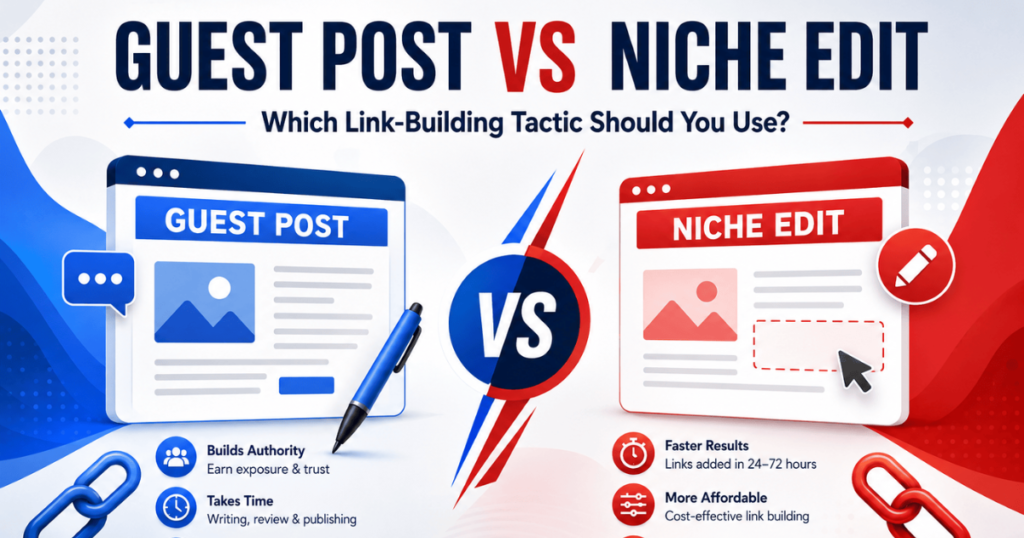
Guest posts and niche edits are the two most commonly used tactics for building backlinks with a specific target page and anchor text in mind. Both can move rankings. Both can also waste your budget if you buy the wrong placement. The real difference isn’t which one is “better” — it’s what each one is built to do, what it costs, how fast it works, and how much control and risk you’re taking on.
Here’s the short version: a guest post is a new article you (or a writer you hire) create for someone else’s website, with a link back to your site inside the content. A niche edit — also called a link insertion or curated link — skips the new content entirely and adds your link into an article that’s already published, indexed, and ranking. This guide breaks down the practical differences so you can decide which one fits your site, budget, and timeline.
What Is a Guest Post?
A guest post is an article you write (or have written) and publish on someone else’s website, with a backlink to your site embedded naturally in the body content. The host site gets original content for its audience; you get a link, and often, exposure to a new set of readers.
Guest posting typically involves:
- Finding relevant, actively-publishing sites in your niche
- Pitching a topic or submitting a full draft
- Going through an editorial review (a real editorial process, not a rubber stamp, is what separates a legitimate guest post from a link-farm placement)
- Publishing new content with your link and, usually, an author bio
Because you’re creating the content, you control the topic, the surrounding context, the anchor text, and often get a byline that builds your personal or brand authority. That control is the main advantage — and the main reason it takes longer.
What Is a Niche Edit?
A niche edit adds your link into an article that already exists, is indexed, and is often already ranking for relevant terms. Instead of creating anything new, you (or an outreach team) identify a live, topically relevant page, then ask the site owner to insert a link — sometimes for a fee, sometimes in exchange for a genuine content improvement.
Niche edits typically involve:
- Finding indexed, relevant articles with real organic traffic (traffic matters more than domain-level metrics like DR)
- Reaching out to the site owner or editor
- Negotiating placement of a link into a specific sentence or paragraph
- Skipping content creation entirely
The appeal is speed and lower cost. You’re borrowing equity from a page that’s already proven itself in search, rather than waiting for a brand-new page to get crawled, indexed, and to earn trust on its own.
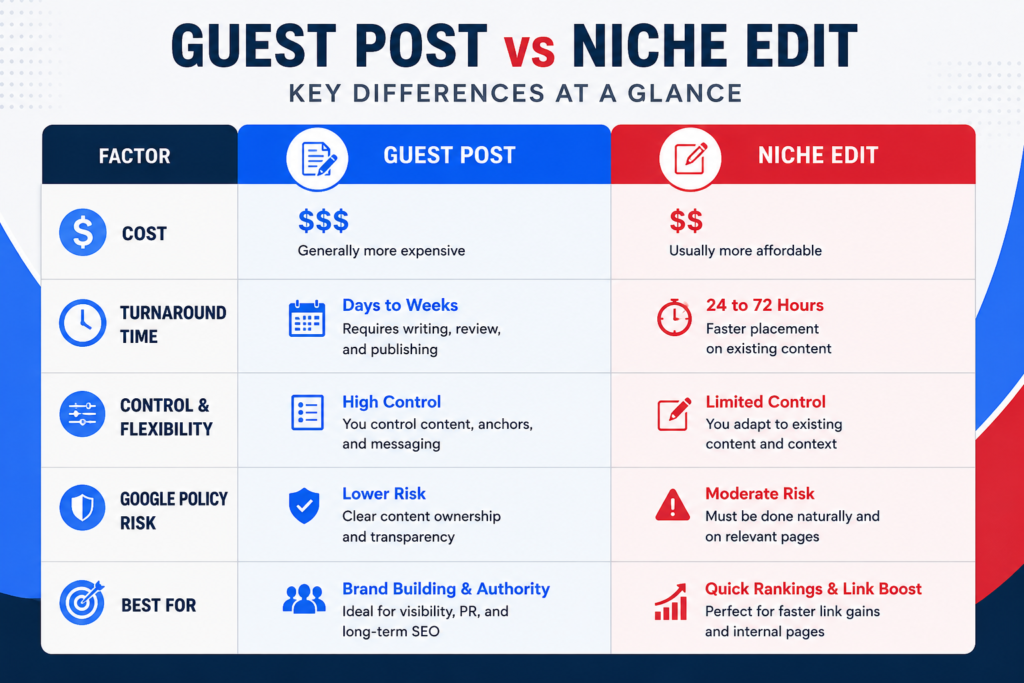
Guest Post vs Niche Edit: Key Differences at a Glance
| Factor | Guest Post | Niche Edit |
| What it is | New article published on a host site | Link added to an existing, live article |
| Content creation | Required (yours or a hired writer’s) | None |
| Typical turnaround | Weeks (pitching, writing, editing, publishing) | Days (negotiation and insertion only) |
| Control over context | High — you write the surrounding content | Lower — you’re working within existing text |
| Anchor text control | Full control, set at creation | Negotiated, sometimes limited by existing copy |
| Typical cost per link | Roughly $300–$460 on average, ranging from under $100 to $1,000+ for premium sites | Roughly $180–$360 on average, generally 30–55% cheaper than a comparable guest post |
| Brand/visibility benefit | Byline, author bio, exposure to a new audience | Minimal — no byline, no new content to showcase |
| Best for | Long-term authority, brand visibility, relationship building | Fast, budget-efficient link placement on proven pages |
| Google policy risk | Lower when the content is genuinely valuable and editorially reviewed | Slightly higher scrutiny on paid, undisclosed insertions — see below |
Cost Comparison: Guest Posts vs Niche Edits
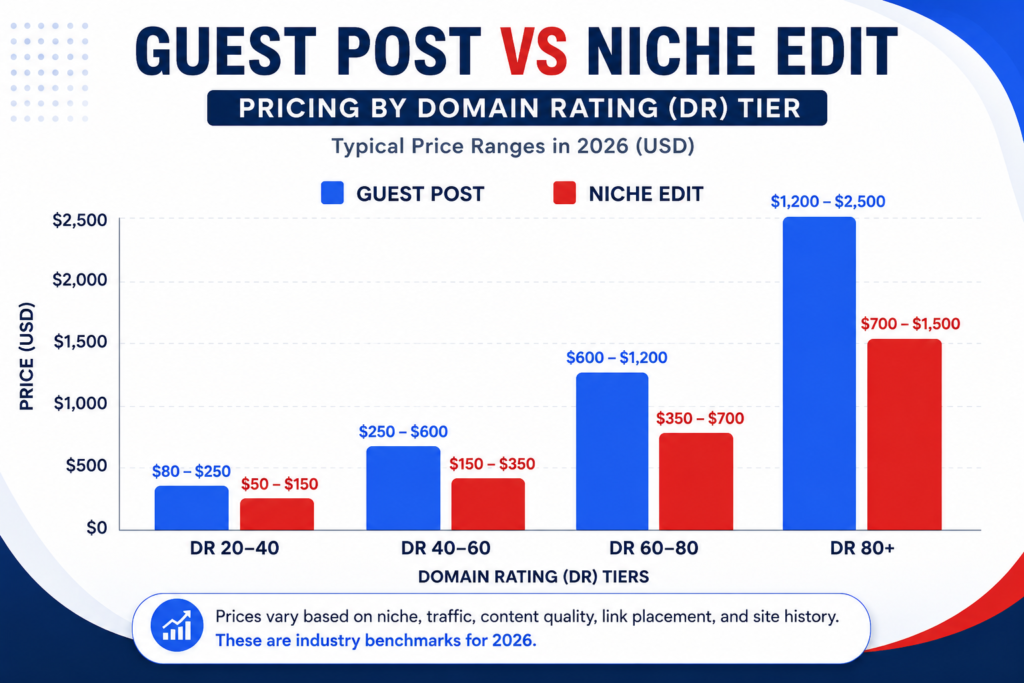
Pricing across the industry is inconsistent — different vendors and marketplaces report different averages — but a few consistent patterns show up across multiple independent cost studies:
- Niche edits are consistently cheaper than guest posts, typically by somewhere between 30% and 55%, because there’s no content-creation cost involved.
- Guest post pricing generally runs from roughly $100 at the low end to $900+ for premium, high-traffic publishers, with reported averages clustering in the $300–$460 range depending on the study and whether you’re buying direct from a site or through a vendor/agency markup.
- Niche edit pricing generally runs from roughly $50 to $700+ depending on Domain Rating tier, with reported averages in the $180–$360 range.
- Domain Rating (DR) is the single biggest price driver for both tactics — each jump in DR tier tends to increase price more than any other single factor, though real organic traffic on the host page is what actually predicts impact, not DR alone.
- Listed prices and actual transaction prices often differ substantially. Marketplace sticker prices tend to run well above what buyers typically negotiate or pay in practice.
The practical takeaway: if you’re quoted a price for either tactic that’s drastically below these ranges (think $15–$30 for a supposedly high-DR placement), the economics don’t work for genuine outreach — that placement is very likely coming from a private blog network, an automated process, or a site the seller controls.
Speed and Turnaround
Niche edits win decisively on speed. Because there’s no writing, editing, or publishing cycle, a niche edit can often go live within days of an agreement. A guest post involves pitching, writing or briefing a writer, going through editorial review, and waiting for a publish slot — a process that commonly takes two to six weeks per placement, sometimes longer on selective, high-authority sites.
If your priority is getting a link live before a product launch, seasonal campaign, or a specific ranking push, niche edits are the faster lever.
Which One Is Safer? Google’s Policy Position, Explained
This is where a lot of guides oversimplify. Neither tactic is inherently against Google’s guidelines — and neither is automatically safe. What matters is how the link is acquired and disclosed.
What Google’s spam policies actually say
Google’s link spam policy prohibits buying or selling links that pass ranking credit without proper disclosure (rel=”sponsored” or rel=”nofollow”), regardless of whether the link sits in a brand-new article or an existing one. Google’s guidance has also specifically flagged content created mainly to host a paid link — thin guest posts published purely as link vehicles, or an inserted paragraph that exists only to carry an anchor — as a form of low-value content built to manipulate ranking signals.
Why niche edits carry a slightly different risk profile
Niche edits get flagged more often in practitioner discussions for a specific structural reason: an old, previously-published article suddenly gaining a new outbound link months or years after it went live is a detectable pattern, especially at volume. A single, well-placed, topically relevant niche edit is low-risk. Buying dozens of niche edits across a marketplace in a short window creates a footprint that’s easier for automated detection systems to flag than the same number of guest posts spread across genuinely different publishers and contexts.
The bottom line most experienced link builders land on: the tactic itself is not the risk factor. Placement quality, topical relevance, disclosure, and volume/velocity are what determine risk — for both guest posts and niche edits alike.
SEO Value: Which Delivers a Stronger Ranking Impact?
There’s no universal winner here, and any source that claims one tactic definitively outranks the other for all sites is oversimplifying. What the available evidence and practitioner consensus point to:
- Niche edits often show ranking movement faster because the host page is already indexed, crawled regularly, and carries established authority — your link benefits from that immediately rather than waiting for a new page to earn trust.
- Guest posts tend to compound over time through brand visibility, referral traffic, relationship building, and the possibility of additional organic mentions or links that a byline and audience exposure can generate — benefits a niche edit structurally can’t offer.
- Topical relevance and host-page traffic matter more than the tactic itself. A topically matched placement on a page with genuine readers reliably outperforms an equivalent placement on an irrelevant or traffic-less page, regardless of whether it’s a guest post or a niche edit.
When to Choose a Guest Post
Guest posting fits best when:
- You want editorial control over the content, context, and messaging around your link
- Brand visibility, a byline, and audience exposure matter as much as the link itself
- You’re building a long-term relationship with a publisher, not a one-off placement
- Your budget and timeline can accommodate weeks of pitching, writing, and review
- You have (or can hire) genuinely strong writing — thin, generic guest posts are both low-value for readers and higher-risk from a policy standpoint
When to Choose a Niche Edit
Niche edits fit best when:
- You need a link live quickly (launch, campaign, or time-sensitive ranking push)
- Budget efficiency matters more than brand exposure
- You’ve found a genuinely relevant, high-traffic page where your link adds real value to readers
- You’re supplementing an existing link profile rather than building a publisher relationship
- You have the capacity to vet host pages carefully (traffic, relevance, editorial standards) rather than buying in bulk from a marketplace
Can You Use Both?
Yes — and in practice, most mature link-building programs do exactly this. A common approach: use guest posts to build foundational authority, brand visibility, and relationships with a smaller number of high-quality publishers, and use niche edits selectively to fill gaps quickly on pages that are genuinely relevant to a specific target URL. Treating this as an either/or decision usually isn’t necessary; treating it as a portfolio decision — matched to budget, timeline, and how much control you need over each individual placement — tends to produce a more resilient link profile than betting entirely on one tactic.
How to Vet a Guest Post or Niche Edit Opportunity Before You Pay
Before paying for either type of placement, check:
- Real organic traffic, not just a DR or DA score — use a comparing tools like Ahrefs, Semrush, or Google’s own indexing tools to confirm the page or site actually gets visits, not just backlinks.
- Topical relevance — would this link make sense to a human reader of this specific page, not just a bot?
- Editorial standards — does the site have a genuine review process, or does it accept anything for a fee?
- Existing outbound link patterns — a page riddled with unrelated paid links is a red flag regardless of its metrics.
- Disclosure practices — will the link carry a rel=”sponsored” attribute if payment is involved, or is the arrangement being hidden from both readers and Google?
- Placement history — for niche edits specifically, check whether the page has a pattern of accumulating new outbound links long after publication, which suggests it’s a known link-insertion target.
Common Mistakes to Avoid
- Buying in bulk from a marketplace without individually vetting each page. Volume without vetting is the fastest way to end up with a manipulated or devalued link profile.
- Chasing DR/DA instead of traffic and relevance. A high-DR page with no real readers is often worse than a mid-DR page with an engaged audience.
- Ignoring disclosure requirements. Skipping rel=”sponsored” on paid placements is a documented policy violation, not a technicality.
- Treating price as the only quality signal. Extremely cheap placements at scale usually indicate PBNs or automated processes, not genuine outreach.
- Publishing thin, purely link-motivated guest content. If the article wouldn’t exist without the link, it’s a weaker signal — and a bigger risk — than genuinely useful content.
FAQ
1. Is a niche edit the same as a guest post?
No. A guest post is a brand-new article published on another site with your link inside it. A niche edit adds your link into an article that’s already published and indexed — no new content is created.
2. Which is cheaper, a guest post or a niche edit?
Niche edits are generally cheaper, often by 30–55%, because you’re not paying for content creation. Reported 2026 averages put guest posts in the roughly $300–$460 range and niche edits in the roughly $180–$360 range, though both vary widely by Domain Rating, niche, and traffic.
3. Are niche edits against Google’s guidelines?
Not inherently. A relevant, genuinely valuable niche edit is treated like any editorial link. What violates Google’s policies is a paid link inserted without proper disclosure (rel=”sponsored”), or a link inserted into content created solely to host that link. The same rule applies to paid guest posts without disclosure.
4. Which one is better for SEO?
Neither is universally “better.” Niche edits often show faster ranking movement because the host page is already indexed and trusted. Guest posts tend to add more value over time through brand visibility and audience exposure. Topical relevance and real page traffic matter more to outcomes than which tactic you choose.
5. Can I use both guest posts and niche edits in the same campaign?
Yes. Many link-building programs use guest posts to build authority and relationships with a smaller set of quality publishers, and niche edits to fill in gaps quickly on genuinely relevant, high-traffic pages.
6. How do I know if a niche edit or guest post opportunity is low quality?
Check real organic traffic (not just DR/DA), topical relevance to your page, whether the site has genuine editorial standards, and whether the price is unrealistically low for the claimed authority level. Extremely cheap, high-DR placements are a red flag for private blog networks or automated link schemes.