

You started your Shopify store with a big dream and probably a tight budget.
You’re wearing ten hats at once — handling orders, updating products, running social media, and somehow trying to bring customers back for a second purchase. Sound familiar?
Here’s the thing most new store owners don’t realize until it’s too late: social media doesn’t own your audience. Email does.
When Instagram changes its algorithm or your ad budget runs dry, your email list is still there — ready to hear from you. And for Shopify small businesses specifically, email marketing delivers an average ROI of $36–$42 for every $1 spent. That’s not a typo.
But here’s the problem — there are dozens of email tools out there, all claiming to be the “best for Shopify.” Some are overkill for a small store. Some are too expensive. And some just don’t integrate well with Shopify at all.
That’s why we tested and reviewed the top options so you don’t have to waste hours figuring it out yourself.
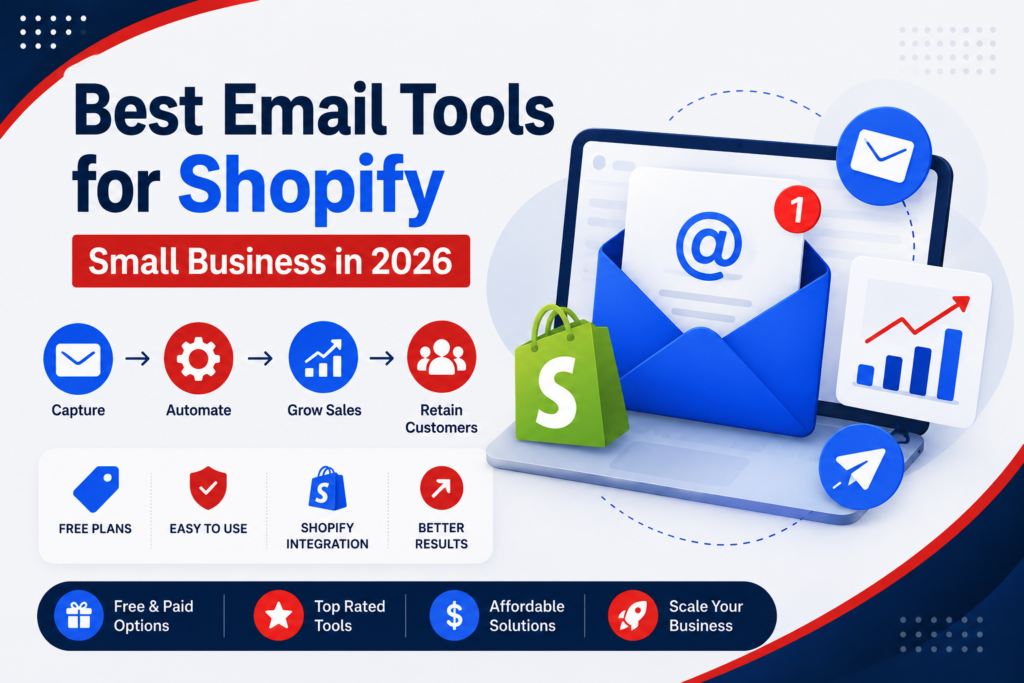
Whether you’re just starting out or already getting consistent orders, this guide will help you find the right email tool for your store size, your budget, and your goals — right now in 2026.
Why Shopify Small Businesses Need a Dedicated Email Tool
A lot of small store owners skip email marketing entirely in the beginning. They focus on Instagram posts, TikTok videos, and paid ads. And that’s understandable — those channels feel more exciting.
But here’s what the data keeps telling us: email converts better than almost every other channel for ecommerce.
Think about this for a second. When someone gives you their email address, they’re saying, “Yes, I want to hear from you.” That’s a warm audience. Compare that to someone scrolling past your ad on Facebook — they didn’t ask to see you.
For a small Shopify business, email marketing helps you do three things really well:
1. Bring customers back. Someone bought from you once. A well-timed email — maybe a discount, maybe a “you might also like this” — brings them back for a second purchase. Repeat customers are far cheaper to win than new ones.
2. Recover lost sales. Did you know that roughly 70% of shoppers abandon their carts before checkout? An automated abandoned cart email can recover a big chunk of that lost revenue while you sleep.
3. Build real relationships. Regular emails keep your brand top of mind. When your customer is ready to buy again, they’ll think of you first — not your competitor.
Now, could you technically do all this with basic Shopify Email? Yes, to a point. But as your store grows, you’ll need smarter automation, better segmentation, and deeper insights. That’s where dedicated email tools come in.
What to Look for in a Shopify Email Marketing App
Before we jump into the tools, let’s talk about what actually matters when choosing one. Don’t just pick the most popular name — pick the one that fits your business.
Here’s a simple checklist to guide you:
Shopify Integration Depth
However, email is only one part of ecommerce growth. A well-optimized store also needs strong Shopify SEO services to attract customers through organic search. You want it to automatically pull in customer data, order history, and product details. The tighter the integration, the smarter your emails can be.
Automation for Abandoned Carts
This is non-negotiable. Abandoned cart emails are the single highest-converting automation you can set up. If a tool doesn’t offer this on its free or entry-level plan, think twice.
Pricing That Fits a Small Business Budget
Some tools charge based on the number of contacts, others on the number of emails sent. For a small store with a growing list, you want transparent pricing with a solid free plan to start. Watch out for tools that get expensive fast as your list grows.
Ease of Use (No Tech Skills Needed)
You shouldn’t need to hire a developer to send a welcome email. Look for a drag-and-drop editor, pre-built templates, and clear onboarding. Your time is valuable — the tool should save it, not drain it.
Best Email Tools for Shopify Small Business — Quick Comparison Table
| Tool | Free Plan | Starting Price | Best For | Shopify Integration |
|---|---|---|---|---|
| Shopify Email | 10,000 emails/mo | $1/1,000 after | Built-in simplicity | Native |
| Omnisend | 500 emails/mo | $16/mo | Automation + SMS | Native |
| Klaviyo | 500 emails/mo | ~$20/mo | Scaling stores | Native |
| Sequenzy | 2,500 emails/mo | $19/mo | AI + lifecycle automation | Native |
| Mailchimp | 500 contacts | $13/mo | Beginners | Direct |
| MailerLite | 1,000 subscribers | $9/mo | Clean design + value | Direct |
| Brevo | 300 emails/day | $9/mo | Email + SMS combo | Direct |
| Seguno | 250 subscribers | $35/mo | Shopify-native users | Native |
Shopify Email — Best Free Built-In Option
If you’ve just launched your store and you’re not ready to commit to a paid tool yet, Shopify Email is the most logical starting point. It lives right inside your Shopify admin — no new login, no learning curve, no extra setup.
What it does well:
Shopify Email gives you 10,000 free emails per month, which is genuinely enough for most stores just getting started. It comes with a clean drag-and-drop editor, pre-built templates that automatically pull in your store’s logo and brand colors, and basic automation flows like welcome emails and abandoned cart messages.
As of early 2026, Shopify added improved analytics so you can see who opened your emails, who clicked, and who unsubscribed. It also syncs your customer segments directly from Shopify — so you can target people who bought in the last 30 days, for example, without doing any manual work.
Where it falls short:
It’s a starter tool, not a growth tool. The automation is basic, segmentation options are limited, and A/B testing is minimal compared to dedicated platforms. If you want to build complex flows — like a 5-email welcome series or behavior-triggered campaigns — you’ll quickly hit its ceiling.
Pricing:
- Free: 10,000 emails per month
- After that: $1 per 1,000 emails (drops to $0.65 at higher volumes)
Our verdict: Start here if you’re on zero budget. Outgrow it proudly — that means your business is growing.
Omnisend — Best for Automation on a Small Budget
Small Shopify stores that want powerful ecommerce automation without paying Klaviyo prices.
Omnisend is the sweet spot for most growing Shopify small businesses. It was built specifically for ecommerce — not repurposed from a general email tool — and that makes a real difference in how well it understands your store’s data.
What it does well:
The automation is where Omnisend really shines. Even on the free plan, you can set up abandoned cart emails, welcome series, and post-purchase follow-ups. The pre-built workflow templates mean you don’t have to build automations from scratch — you just turn them on and customize the copy.
Omnisend also supports email + SMS + web push notifications all in one place. For a small store, having all three channels inside one dashboard saves both time and money.
The segmentation tools are solid too. You can target customers based on purchase behavior, browsing activity, email engagement, and more — without needing a data science degree.
Where it falls short:
The free plan limits you to 500 emails per month and 250 contacts, which you’ll outgrow quickly if your list is growing. Advanced reporting features are locked behind higher-tier plans.
Pricing:
- Free: 250 contacts, 500 emails/month
- Standard: From $16/month (500 contacts, 6,000 emails)
- Pro: Unlimited emails
Klaviyo — Best for Growing Stores That Want to Scale
Shopify stores that are past the startup phase and ready for serious, data-driven email marketing.
Klaviyo is the big name in Shopify email marketing — and for good reason. Over 117,000 brands use it, and it has some of the deepest Shopify integration of any tool on this list. When you connect Klaviyo to Shopify, it syncs your customer data in real time — every purchase, every browse, every click.
What it does well:
The segmentation in Klaviyo is genuinely impressive. You can create audiences based on incredibly specific behaviors — like “customers who bought product X but haven’t come back in 60 days” or “subscribers who opened my last 3 emails but never purchased.” This level of targeting drives real revenue.
The AI features are growing fast too. Klaviyo now uses AI to suggest optimal send times, generate subject lines, and predict which customers are most likely to churn — all useful for a small team with limited time.
Where it falls short:
It’s more expensive than the alternatives as your list grows. Smaller stores sometimes find the interface overwhelming at first. And free-plan users only get email support for the first 60 days — after that, you’ll need to pay to access support.
Pricing:
- Free: Up to 500 emails/month, 250 contacts
- Paid: Starts around $20/month, scales with contact count
Mailchimp — Best for Beginners Who Already Know the Brand
First-time email marketers who want a familiar, user-friendly platform with plenty of tutorials and community support.
Mailchimp is probably the most recognizable name in email marketing. It’s been around since 2001, and that history shows — the interface is polished, the templates are plentiful, and there’s a huge amount of documentation and YouTube tutorials if you ever get stuck.
What it does well:
The drag-and-drop editor is genuinely easy to use, even if you’ve never sent a marketing email before. The template library is one of the largest available. Mailchimp also offers a decent free plan for very small lists, and its Customer Journey builder lets you create automated sequences visually.
Where it falls short:
Here’s the honest truth — Mailchimp’s Shopify integration has had a bumpy history. They fell out and reunited, and while the integration works, it’s not as seamless or deep as Klaviyo or Omnisend. Also, Mailchimp’s pricing gets expensive quickly as your list grows, and some ecommerce-specific features (like revenue attribution) feel bolted on rather than built in.
Pricing:
- Free: Up to 500 contacts, 1,000 emails/month
- Essentials: From $13/month
Sequenzy – Best for AI-Native Shopify Lifecycle Marketing
Small Shopify businesses that want email, transactional messaging, and SMS automation without paying based on contact count.
Sequenzy is an AI-native lifecycle marketing platform built for ecommerce and SaaS businesses. Its Shopify integration syncs customers, orders, products, and store activity, allowing merchants to create campaigns and automations using real purchase behaviour.
What it does well:
Sequenzy brings marketing email, transactional email, SMS, and MMS into one platform. Shopify stores can build welcome sequences, abandoned-cart reminders, post-purchase follow-ups, win-back campaigns, and product-based automations. Dynamic segments update automatically using purchase history, engagement, tags, and custom customer attributes.
Its AI capabilities also go beyond generating subject lines and email copy. AI agents can work directly with subscribers, segments, campaigns, automations, and analytics through MCP, CLI, and REST API access. Store owners can still manage everything through the visual dashboard and drag-and-drop editor.
Another advantage is volume-based pricing. Every plan includes unlimited contacts, lists, segments, domains, and team members, so growing your subscriber list does not automatically increase your bill. Revenue attribution also connects campaigns and automations to Shopify purchases.
Where it falls short:
Sequenzy is a newer platform, so its template library, integration ecosystem, and community are smaller than Klaviyo or Omnisend. It also does not currently offer the same depth of predictive product recommendations as Klaviyo.
Pricing:
Free: 2,500 emails per month with unlimited contacts
Email plans: From $19 per month for 15,000 emails
SMS and MMS add-on: $16 per month with 1,000 messaging credits
Our verdict: Sequenzy is a strong option for small Shopify stores that want lifecycle automation, email, SMS, and AI-agent capabilities without contact-based pricing.
MailerLite — Best Affordable Pick with Clean Design
Budget-conscious Shopify owners who want a clean, simple tool with a generous free plan.
MailerLite doesn’t get as much attention as Klaviyo or Omnisend, but it quietly delivers a lot of value — especially for small businesses watching every dollar.
What it does well:
The free plan is one of the most generous in the industry — 1,000 subscribers and 12,000 emails per month at no cost. The interface is clean and simple, making it easy to build good-looking emails without a design background.
MailerLite also includes landing pages, pop-up forms, and a basic automation builder, all on the free plan. The Shopify integration syncs customer data, purchase events, and abandoned carts.
Where it falls short:
It’s not as ecommerce-focused as Omnisend or Klaviyo. The automation builder is functional but not as powerful. If you want deep behavioral segmentation or advanced reporting, you’ll hit some walls.
Pricing:
- Free: 1,000 subscribers, 12,000 emails/month
- Growing Business: From $9/month
Brevo — Best for Email + SMS Combo
Shopify small businesses that want email and SMS marketing in one affordable platform.
Brevo (formerly Sendinblue) rebranded a couple of years ago but the product kept getting better. It’s an all-in-one platform that handles email, SMS, WhatsApp campaigns, live chat, and even a built-in CRM — all at a price point that won’t scare small business owners.
What it does well:
Brevo’s pricing model is unique — instead of charging by contact count, it charges by emails sent. This is a huge advantage if you have a large list but don’t email them every day. You can have 10,000 contacts and still use the free plan as long as you stay under 300 emails per day.
The automation builder is intuitive, and the Shopify integration covers the basics: abandoned carts, order confirmations, and customer re-engagement flows.
Where it falls short:
The Shopify integration isn’t quite as seamless as Omnisend or Klaviyo — it takes a bit more setup. Advanced ecommerce analytics are limited to lower plans.
Pricing:
- Free: 300 emails/day, unlimited contacts
- Starter: From $9/month for 5,000 emails
Seguno — Best Native App Built Only for Shopify
Shopify store owners who want everything managed directly inside their Shopify dashboard without switching tabs.
Seguno is a lesser-known name but it has one unique selling point that no other tool on this list can match — it is built exclusively for Shopify. You never leave your Shopify admin to use it. Everything — writing emails, setting up automations, reviewing analytics — happens right where you already work.
What it does well:
Because it’s built only for Shopify, the integration is as tight as it gets. It taps directly into Shopify’s data, customer segments, and discount engine. The workflow is simple and familiar for anyone already comfortable with Shopify’s interface.
It also handles back-in-stock emails, welcome series, abandoned cart flows, and basic newsletters — all the essentials for a small store.
Where it falls short:
Seguno’s feature set is narrower than the bigger platforms. It doesn’t support SMS marketing, the free plan is limited to 250 subscribers, and it gets pricey faster than alternatives like MailerLite or Brevo for growing lists.
Pricing:
- Free: Up to 250 subscribers
- Standard: $35/month for 251–2,500 subscribers
Klaviyo vs Omnisend — Which Is Better for Shopify Small Business?
This is one of the most common questions small Shopify store owners ask, so let’s settle it clearly.
Choose Klaviyo if:
- You’re generating consistent revenue and want to maximize it with advanced segmentation
- You want AI-powered send time optimization and predictive analytics
- You’re planning to scale to a mid-size or larger store
- You’re comfortable with a steeper learning curve in exchange for more power
Choose Omnisend if:
- You’re a small or newer store watching your monthly costs
- You want strong automation without the complexity
- You need email + SMS + push notifications in one affordable package
- You want quick, easy setup with pre-built ecommerce workflows
How to Choose the Right Tool Based on Your Store Size
Not every store is at the same stage, and the right tool depends heavily on where you are right now.
If you’re just starting out (0–500 subscribers): Start with Shopify Email or MailerLite. Both are free at this stage. Focus on setting up a welcome email and an abandoned cart flow — those two alone will make a measurable difference. Don’t overthink it.
If you’re growing steadily (500–5,000 subscribers): This is where Omnisend or Brevo makes the most sense. You need proper automation, better segmentation, and ideally SMS as a backup channel. Your email list is an asset now — treat it like one.
If you’re scaling up (5,000+ subscribers): Klaviyo is the natural next step. At this stage, the advanced analytics and behavioral segmentation will directly translate into revenue. The cost is justified when your list is working hard for you.
How to Set Up Your First Email Campaign on Shopify
If you’re new to email marketing, the setup can feel overwhelming. Here’s a simple path to your first campaign:
Step 1 — Install your chosen tool. Head to the Shopify App Store, install the app, and connect it to your store. Most tools will import your existing customer list automatically.
Step 2 — Set up your welcome email first. Every new subscriber should get a warm welcome. Introduce your brand, tell people what makes you different, and give them a small incentive — even 10% off their first order works well.
Step 3 — Turn on your abandoned cart email. This is the highest-ROI thing you can do. Set it to send 1–2 hours after a cart is abandoned. Keep the email short: remind them what they left, show the product image, and make it easy to come back and complete the checkout.
Step 4 — Build a simple newsletter habit. Once or twice a month, send your list something useful — a new product, a seasonal offer, or a behind-the-scenes story. Consistency matters more than frequency.
Step 5 — Watch your numbers. Open rate, click rate, revenue per email. Over time, you’ll see what your audience responds to. Double down on that.
Conclusion
You don’t need the most expensive or most complex email tool to see real results from your Shopify store.
You need the right tool for where you are right now — one that integrates smoothly with Shopify, helps you recover abandoned carts, and lets you stay in touch with your customers without eating up your entire week.
If you’re just starting out, MailerLite or Shopify Email will take you further than you think. If you’re growing and ready for serious automation, Omnisend is the sweet spot for small businesses in 2026. And if you’re scaling fast and want to squeeze every dollar out of your list, Klaviyo is built for exactly that.
FAQs
1. What is the best free email marketing tool for Shopify?
For most small Shopify stores, MailerLite offers the most generous free plan — 1,000 subscribers and 12,000 emails per month at no cost. If you want something that lives inside Shopify itself, Shopify Email is the best free built-in option with 10,000 free emails per month.
2. Does Shopify have a built-in email tool?
Yes. Shopify has its own email marketing tool called Shopify Email (previously part of Shopify Messaging). It’s free to install on all plans and gives you 10,000 emails per month at no charge. It’s a solid starting point for new stores.
3. Is Klaviyo free for small businesses?
Klaviyo has a free plan that covers up to 250 contacts and 500 emails per month. It’s enough to test the platform, but small businesses with growing lists will typically need to move to a paid plan relatively quickly.
4. What email tool works best for abandoned cart recovery on Shopify?
Omnisend and Klaviyo are both excellent for abandoned cart recovery. Omnisend’s pre-built abandoned cart workflow can be activated in minutes. Klaviyo gives you more advanced control over timing, copy, and segmentation if you want to optimize further.
5. How many emails should a small Shopify store send per month?
There’s no single right answer, but a good starting point is 4–6 emails per month — roughly one to two per week. This keeps your brand top of mind without overwhelming your subscribers. More important than frequency is relevance — make sure every email gives your reader a reason to open it.