

Summarize this blog post with: ChatGPT | Claude | Grok
You already track keyword rankings and organic traffic, but those numbers say nothing about whether ChatGPT, Perplexity or Gemini recommend your brand when buyers ask for solutions. That blind spot is exactly what Promptwatch aims to close. In this guide, we’ll explain what Promptwatch is, how it works, what it costs, who it fits, and how it compares to alternatives, so you can decide with confidence.
Key Takeaways
- Promptwatch is an AI search visibility and Generative Engine Optimization (GEO) platform that tracks how brands are mentioned and cited across AI engines such as ChatGPT, Claude, Gemini and Perplexity.
- AI visibility tracking matters because AI-generated answers increasingly shape product discovery, and traditional rank trackers do not measure brand mentions inside those answers.
- The platform measures visibility score, sentiment, share of voice, citations and competitor presence for a set of prompts that represent how buyers ask questions.
- Beyond monitoring, Promptwatch emphasizes optimization, including content gap analysis and content creation designed to earn AI citations.
- Promptwatch suits SEO teams, marketers and agencies that need to report on and improve AI search presence, while very small sites with few target prompts may not need a paid tool.
- Pricing and limits change often, so confirm current plans on the official site and use the free trial or demo to test it against your own prompts.
- The best way to evaluate tools is to compare engine coverage, optimization depth, reporting and cost per tracked prompt, not dashboard polish alone.
What Is Promptwatch and What Does It Do?
Promptwatch is an AI search visibility and Generative Engine Optimization (GEO) platform that helps brands track and improve how they are mentioned across AI engines such as ChatGPT, Claude, Gemini and Perplexity. It is built by Promptwatch B.V., a company headquartered in Amsterdam with an office in New York.
First, the product has two jobs. It monitors what AI engines say about your brand, and it helps you act on what it finds. For example, it can show that Perplexity recommends two competitors for “best CRM for startups” but never mentions you, then points to the content gap behind it.
Moreover, the company has real momentum. Promptwatch says it serves 1,840+ brands and agencies — Source: Promptwatch, 2026. It also raised a reported €6 million seed round to expand the platform — Source: Computable.nl, 2026.
That being said, Promptwatch is still a young product. Always check its official site for the latest features before you buy.
Why Does AI Search Visibility Matter?
AI search visibility is a measure of how often, how prominently and how favorably your brand appears inside AI-generated answers. It matters because buyers now ask AI tools for recommendations instead of scrolling through ten blue links.
First, the audience is huge. Promptwatch reports roughly 2.5 billion ChatGPT prompts per day and 1.2 billion weekly ChatGPT users — Source: Promptwatch, 2026. It also cites 2 billion+ monthly users of Google AI Overviews — Source: Promptwatch, 2026. These are vendor-reported figures, so treat them as directional.
In addition, AI answers shortlist brands before a buyer ever visits a website. For example, if a marketing manager asks Gemini for “the best project tools for agencies,” only the brands named in that answer get considered.
How Does Promptwatch Track Brand Visibility in AI Search?
AI visibility tracking is the process of running a defined set of buyer-style prompts across multiple AI engines on a recurring basis and measuring how often, how prominently and how favorably a brand appears in the answers. Promptwatch automates this loop and turns the results into dashboards.
How Does Promptwatch Collect Its Data?
Promptwatch collects data by scraping the interfaces of the AI tools people actually use, rather than relying only on developer APIs. This matters because the answer a customer sees in ChatGPT’s app can differ from what an API returns. For example, a web-enabled answer may cite live sources that a bare API call would not.
Plus, the setup is light. You enter your brand’s URL, choose about five starter prompts, and Promptwatch begins collecting brand and competitor mentions.
What Metrics Does Promptwatch Report?
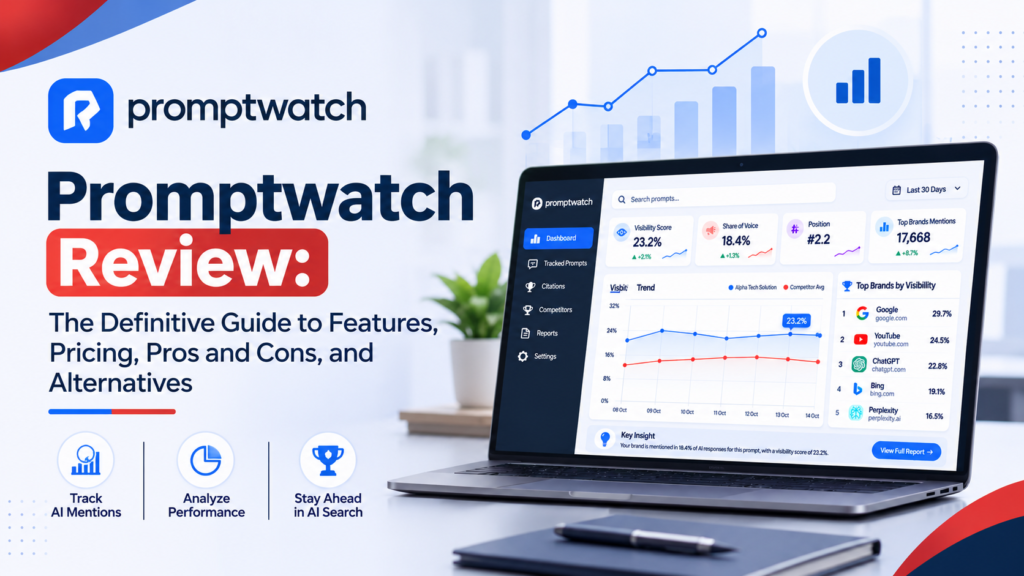
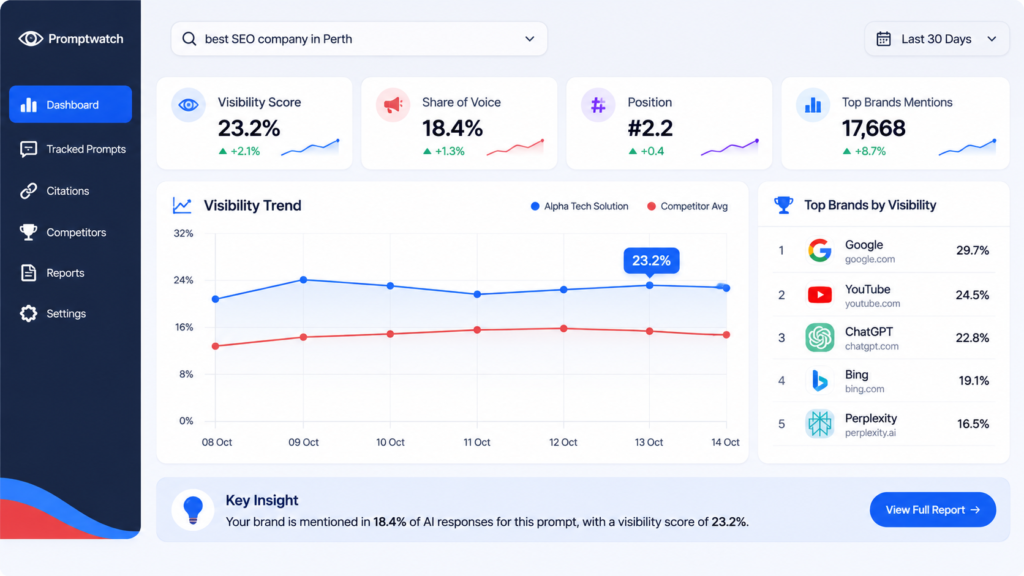
The core metrics are visibility score, sentiment, share of voice, citations and competitor presence. Visibility score shows how often your brand appears across tracked prompts. Share of voice compares your mentions with competitors on the same prompts.
For example, a dashboard might show your brand at 18% share of voice on best CRM for startups while a competitor holds 28%. That gap tells you where to focus.
How Does Citation and Source Analysis Work?
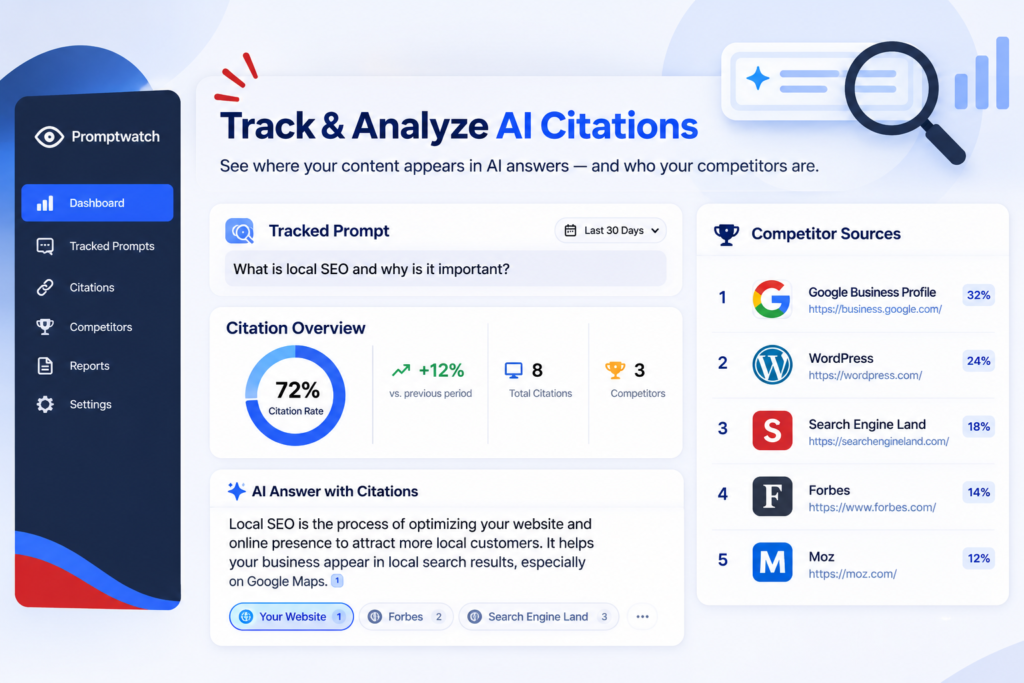
Citation analysis is the practice of identifying which pages and domains AI engines use as sources for their answers. Promptwatch lists the pages AI cites for your prompts, including sources that do not mention you yet. As a result, you can see where to publish content or pursue outreach.
Which AI Engines Does Promptwatch Monitor?
Promptwatch monitors a broad pool of engines, including ChatGPT, Google AI Overviews, Google AI Mode, Microsoft Copilot, Perplexity, Claude, Gemini, Meta AI and DeepSeek. Its pricing page also lists others, such as Mistral and Amazon Alexa.
How Does Promptwatch Differ from Traditional SEO Rank Trackers?
Traditional rank trackers measure the position of your URL on a search results page, while AI visibility tools measure brand mentions, citations, sentiment and share of voice inside generated answers. The two answer different questions, so they complement each other.
| Dimension | Traditional rank tracker | Promptwatch (AI visibility) |
|---|---|---|
| What it tracks | URL position for keywords | Brand mentions in AI answers |
| Core metric | Rank (1–100) | Visibility score, share of voice |
| Data source | Search results pages | AI chat and AI search interfaces |
| Key insight | Where you rank | Whether AI recommends you |
| Action it drives | On-page and link work | Content gaps, citations, outreach |
For example, you could rank #3 on Google for “CRM software” and still never appear in a ChatGPT answer for the same topic. Only an AI visibility tool would reveal that.
What Features Does Promptwatch Offer for GEO and AI Optimization?
Promptwatch’s feature set covers tracking, analysis and action, which is what separates it from simple monitoring dashboards. Let’s take a look at the features that matter most.
Prompt Tracking and Personas
Prompt tracking lets you monitor real buyer questions across engines, and personas let you phrase those prompts the way different audiences would. A budget-focused buyer and an enterprise buyer ask different questions. It can also run prompts by country, language and, on higher plans, city.
Content Gap Analysis and AI Content Creation
Content gap analysis is the process of mapping your content against AI answers to find topics where you have no coverage. Promptwatch then offers content agents that draft and refresh articles using citation data, and they can publish to WordPress, Webflow or Framer.
For example, if AI engines cite comparison pages for your category and you have none, that gap becomes a content task.
Crawler and Agent Analytics
Agent analytics is the tracking of which AI crawlers visit your site, which pages they read, and how often. Promptwatch connects to your CDN, such as Cloudflare, to show this. Moreover, a site health check audits whether AI agents can reach and read your pages.
Fact-Checking, Reporting and Agency Use
Fact-checking compares what AI says about your brand with your own knowledge base. For example, it can flag an AI answer that quotes an outdated price. On top of that, all plans include unlimited seats, and the platform offers an agent chat, API, MCP access and Slack integration. This setup is useful for client reporting.
How Much Does Promptwatch Cost, and Is There a Free Trial?
Promptwatch pricing starts at $95 per month for the Essential plan, with higher tiers for more prompts, projects and features. The official pricing page also offers a free trial, though you should confirm the current trial length at signup.
| Plan | Price (Listed) | Projects | Prompts | Notable Features |
|---|---|---|---|---|
| Essential | $95/mo | 1 | 50 | All models, agent chat, country tracking, MCP/API |
| Professional | $245/mo | 2 | 150 | Adds content writing, knowledge base, agent analytics |
| Business | $579/mo | 5 | 350 | Adds city-level tracking, shopping insights, ads radar, fact check |
| Enterprise | Custom | Custom | Custom | SSO, white label, dedicated success manager |
Source: Promptwatch pricing page, 2026 (verify before publishing).
First, compare cost per prompt. By simple math, Essential works out to about $1.90 per prompt, Professional about $1.63, and Business about $1.65. Professional is therefore the best value per prompt on paper.
However, third-party sites list slightly different prices, such as $99 and $249. Billing options and promotions also change. For example, Promptwatch ran a 30% Black Friday offer at the time of writing. Always trust the live pricing page over any review, including this one.
What Are the Pros and Cons of Promptwatch?
Promptwatch’s main strength is that it connects monitoring to action, while its main limits are prompt caps and feature gating by plan. Here is a balanced view.
Pros
- Broad engine coverage across ChatGPT, Gemini, Claude, Perplexity, AI Overviews and more.
- Action-oriented tools such as content gap analysis, a content agent and fact-checking.
- Unlimited seats on every plan, which helps agencies and larger teams.
- Crawler analytics show how AI bots interact with your site.
- Strong public rating: about 4.7 out of 5 on G2 — Source: G2, 2026 (verify current rating and review count).
Cons
- Prompt limits are modest on lower plans (50 prompts on Essential).
- Key features are gated. Content writing and agent analytics begin at Professional, and city tracking and fact-checking begin at Business.
- Organic data lives elsewhere. One competitor roundup notes that reviewers want AI answers shown next to organic results — Source: SE Ranking, 2026. Promptwatch does connect to the Search Console.
- Small review pool on some sites. For example, Capterra lists very few reviews, so ratings there are less reliable — Source: Capterra, 2026.
- AI answers vary from run to run, so any tool’s scores are samples, not absolute truth.
Is Promptwatch Worth It for Agencies and In-House Teams?
Promptwatch is worth it for teams that need to report on and improve AI visibility across many prompts, brands or clients, but not for sites with only a handful of target prompts. The right answer depends on your size and goals.
- Agencies: Unlimited seats, multi-project plans and reporting features suit client work. Check whether the project limits fit your client roster.
- In-house SEO and marketing teams: The content gap tools and crawler analytics help teams turn data into tasks.
- SMBs: If you only need to check a few prompts, a manual process may be enough at first. For example, you can ask ChatGPT and Perplexity the same ten questions each month and log the results in a spreadsheet.
- Enterprise: Business and Enterprise tiers add city-level tracking, audit logs, SSO and white-label options.
What Are the Best Promptwatch Alternatives?
The best Promptwatch alternatives depend on your budget, team size and whether you need monitoring only or full optimization. There is no single winner, so use the “best for” notes below. For a wider market view, see our [Internal link: “best AI visibility tools” → your AI visibility tools roundup].
| Tool | Best for | Pricing note |
|---|---|---|
| Cognizo | Teams wanting many platforms and unlimited seats and regions | Entry plan listed around $499/mo — Source: Toolradar, 2026 |
| Scrunch AI | Teams wanting ready-made industry prompts and share of voice tracking | Core listed at $250/mo for 125 prompts — Source: LLM Pulse, 2026 |
| Otterly.AI | Small teams seeking a low entry price | Described as one of the cheapest published entry prices — Source: Gracker, 2026 |
| Semrush AI Toolkit | Teams already working inside Semrush | Check Semrush for current pricing |
| Profound, Peec AI, AthenaHQ | Commonly shortlisted alongside Promptwatch | Compare current plans directly |
First, when comparing Cognizo vs Promptwatch, Cognizo’s published entry price is much higher, while Promptwatch lists unlimited seats on every plan. Cognizo says it tracks 10 platforms, which is similar to Promptwatch’s wide pool. Test both with your own prompts before deciding.
Second, remember that many “alternatives” articles are written by competing vendors. Compare tools on engine coverage, optimization depth, reporting and cost per tracked prompt, not on dashboard polish alone.
What Is a Good AI Visibility Score and How Do You Improve It?
A good AI visibility score is one that rises over time and beats your closest competitors on the same prompts, because no universal benchmark exists. Scores depend on your industry, prompts and the engines you track.
For example, a 20% visibility score could be strong in a crowded software category and weak in a niche one. So start with a baseline, then compare month over month.
You can improve your score in three ways:
- Fill content gaps with pages that answer the questions AI engines are already answering.
- Earn mentions on cited sources, such as review sites, forums and industry publications.
- Fix inaccurate claims by updating pricing, product and comparison pages so AI engines have correct facts.
How Do You Get Started with Promptwatch?
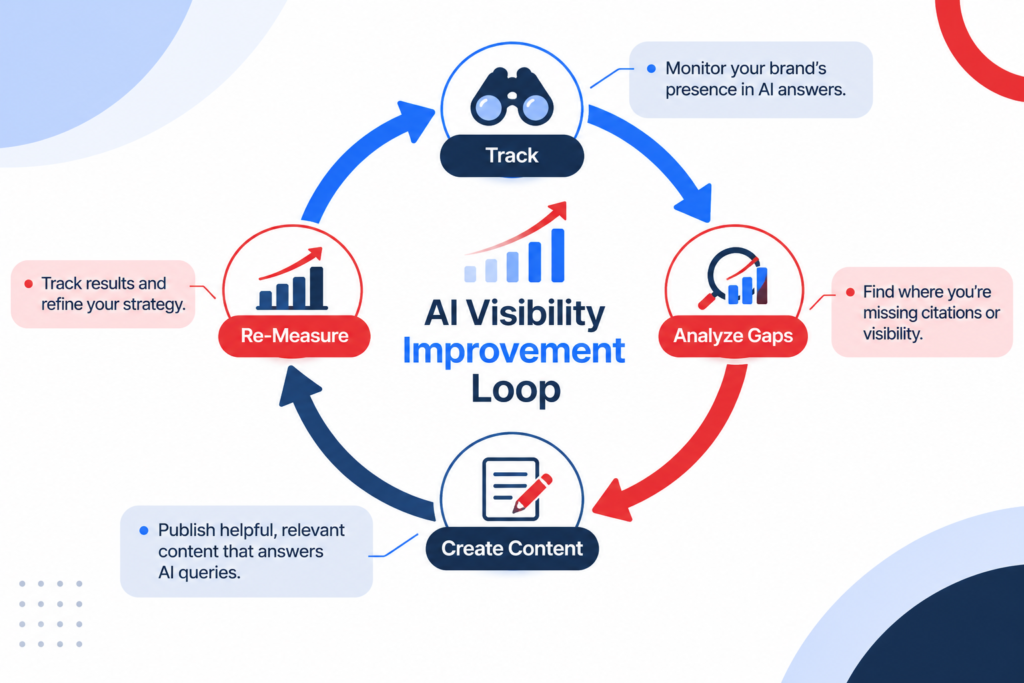
You can get started with Promptwatch in a few steps: add your brand, choose prompts, set a baseline, act on gaps and re-measure. Here is a simple first-30-days plan. For prompt ideas, see our [Internal link: “prompt research for AI search” → your prompt research methodology].
- Days 1–3: Add your brand and competitors. Enter your URL and name three to five rivals.
- Days 3–7: Choose prompts. Pick buyer-style questions, such as “best [category] tool for [audience].” You can also pull ideas from your Google Search Console queries.
- Days 7–14: Capture your baseline. Record visibility score, share of voice and top cited sources.
- Days 14–25: Act on content gaps. Publish or refresh two to four pages based on the gaps.
- Days 25–30: Re-measure. Compare results and decide which actions to repeat.
For free support, use Google Search Console to find your real queries and GA4 to spot AI referral traffic. See our guide on AI traffic attribution in GA4
Conclusion
Promptwatch is a capable AI search visibility and GEO platform that tracks brand mentions across major AI engines and helps you act on the gaps it finds. Its strengths are engine coverage, optimization tools and unlimited seats. Its limits are prompt caps and plan-based feature gating.
Treat AI visibility as a measurable, improvable channel. Start with a baseline, test the tool on your own prompts through the free trial or a demo, and compare it with one or two alternatives. The brands that measure this channel early will be the ones AI recommends next.
FAQs
1. What is Promptwatch and what does it do?
Promptwatch is an AI search visibility and Generative Engine Optimization (GEO) platform that helps brands track and improve how they are mentioned and cited in AI engines such as ChatGPT, Claude, Gemini, and Perplexity. It runs your chosen prompts on a schedule, records which brands and sources appear, and helps you create content to close visibility gaps.
2. How much does Promptwatch cost, and is there a free trial?
Promptwatch offers paid plans starting at roughly $95 to $99 per month, with higher tiers at about $245 and $579 per month, plus custom Enterprise pricing. Several reviews report a 7-day free trial on the lower plans, but plan details change, so confirm current prices and trial terms on the official pricing page.
3. Who is Promptwatch best suited for?
Promptwatch is best suited for SEO teams, agencies, and brands with a dedicated budget for AI search visibility. It works well for teams that want tracking and content workflows in one tool. Very small businesses or teams that need many user seats may find the plan limits restrictive.
4. Which AI engines does Promptwatch monitor?
Promptwatch monitors major AI engines including ChatGPT, Claude, Gemini, and Perplexity, and third-party reviews mention coverage of around nine models. The exact engines available can depend on your plan, so check the current list on the Promptwatch website before you buy.
5. Is Promptwatch worth it?
Promptwatch is worth it if AI search visibility is a real priority for your business and you will act on the data. It combines tracking with content creation, which saves time for busy teams. If you only need occasional checks, you can test prompts manually in ChatGPT, Gemini, and Perplexity for free first.
6. What are the main alternatives to Promptwatch?
Common alternatives include Rankscale, Superlines, Searchable, Profound, and Scrunch. They differ in price, engine coverage, content features, and integrations. Compare them on engine coverage, citation depth, competitor tracking, reporting, and price, and run a short trial of your top two choices.
7. Can Promptwatch help you get cited by AI engines?
Promptwatch can help by showing which sources AI engines cite and which prompts you are losing, then supporting content creation to fill those gaps. It does not guarantee citations. Results depend on the quality, accuracy, and originality of the content you publish.