


SEO content writing means writing a page that answers a search query well, then setting it up so Google can find, read, and rank it. Most beginners get only half of that right. They write a good article nobody finds, or they stuff in keywords and write something nobody wants to read.
This guide walks through the process for planning and writing a blog post for search, from choosing a keyword to checking results three months later. It is written for bloggers, small business owners, and new writers. You can follow every step with free tools, though a keyword tool makes Step 1 faster.
What Is SEO Content Writing?
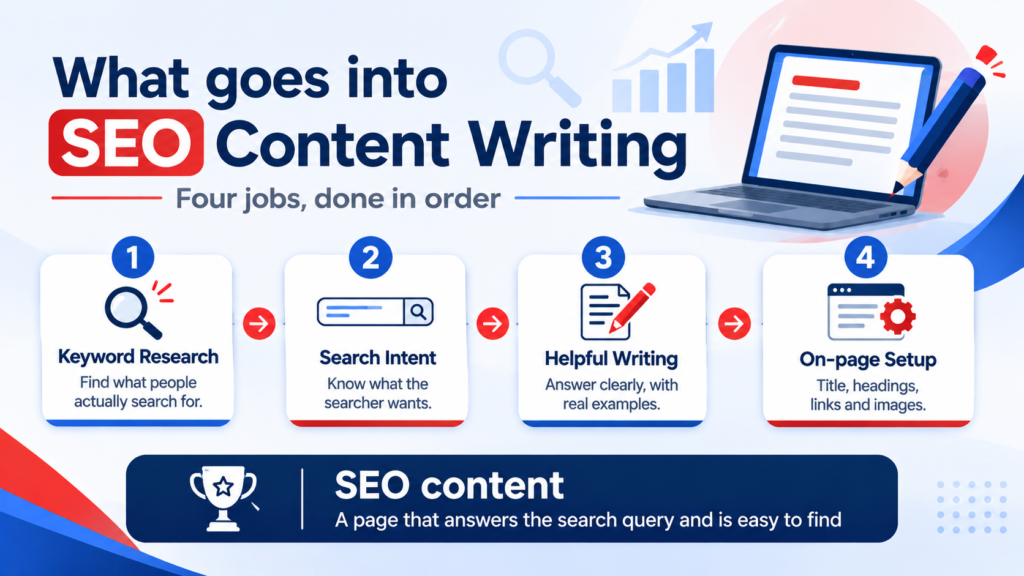
SEO content writing is the process of writing web content that answers a specific search query clearly and is structured so search engines can understand and rank it. It starts with keyword research and search intent, and it ends with a page people actually finish reading.
You will also see it called SEO writing or SEO copywriting. It applies to blog posts, guides, landing pages, and product pages. Anyone doing content writing for SEO has the same two jobs: give the searcher a useful answer, and make that answer easy for a search engine to interpret.
SEO Content Writing vs Regular Content Writing
Regular content writing usually starts with a topic or a brief. A writer is told to “write about running shoes” and picks an angle.
SEO content writing starts with what people type into Google. The same writer checks the searches first and finds people looking for “running shoes for flat feet” or “how often to replace running shoes.” Then they write the page that answers one of those questions better than what already ranks.
The writing skills are the same. The difference is the input: real search data and a look at the current results before a single paragraph is written.
Why SEO Content Writing Matters
A paid ad stops working the day you stop paying. A post that ranks can bring visitors for months or years. People who find you through search also arrive with a question already in mind, so they are often closer to making a decision.
The catch is time. A new page usually needs weeks or months to settle in Google’s results, and a new site with few links waits longer. No one can promise a ranking, and you should be wary of anyone who does.
How to Do SEO Content Writing: 7 Simple Steps
This is the order that works best, and skipping the early steps is the most common reason posts fail.
Step 1: Pick One Topic and One Main Keyword
Choose one main keyword per post. Add a few closely related phrases you can use naturally, but keep the page focused on one question.
Start with specific phrases, not broad ones. “Running shoes” is crowded. “Running shoes for flat feet” is narrower, and the person typing it knows what they want. This matters most for new sites. Win the narrow searches first, then move toward the bigger ones as your site earns trust.
Two places to find keywords for free:
- Google’s autocomplete and “People also ask” box, which show the exact wording real people use.
- Google Search Console, if your site already has data. Look for pages that get impressions but sit on page two or three. Those are often easier to improve than starting from scratch.
A keyword tool such as Ahrefs or Semrush adds search volume and a difficulty score. Treat difficulty as a rough guide. It is based mostly on backlinks, so it does not tell you how good the current pages are.
One more check: make sure you don’t already have a post targeting the same keyword. Two pages chasing the same phrase end up competing with each other.
Step 2: Understand Search Intent
Search intent is the reason behind the search. It decides what kind of page can rank, and it matters more than any other on-page factor.
Most searches fall into one of these groups:
- Informational: the person wants to learn something (“what is seo content writing”).
- Commercial: the person is comparing options (“best seo content writing tools”).
- Transactional: the person wants to buy or hire (“seo content writing services”).
- Local: the person wants something nearby.
The fastest test is to search your keyword and read the results. If the top ten are all how-to guides, a sales page will not break in. If they are all service pages, a blog post will struggle. Match the format, then make yours better.
A keyword can also have mixed intent. “SEO content writing” itself shows mostly guides, with some agency pages mixed in. That tells you a guide is the right choice here.
Step 3: Check What Already Ranks
Open the top five to ten results and take notes. You are looking for:
- The format (guide, list, comparison, video).
- The subtopics almost every page covers. You will need to cover them too.
- What is missing: no examples, outdated advice, no checklist, no beginner explanation.
- The SERP features Google shows, such as People Also Ask, videos, or an AI Overview.
The missing pieces are your opening. When I review a results page, I often find that most pages repeat the same list of tips and none show a finished example. A page that covers the basics and adds one thing the others lack gives Google a reason to include it.
Don’t copy the headings of the top pages. Use them to understand what readers expect, then build your own outline.
Step 4: Build an Outline With Question-Style Headings
Write the outline before the draft. Make each H2 a question or a clear promise, in the order a reader would ask them. For example: “What is X?”, “How do I do X?”, “What mistakes should I avoid?”
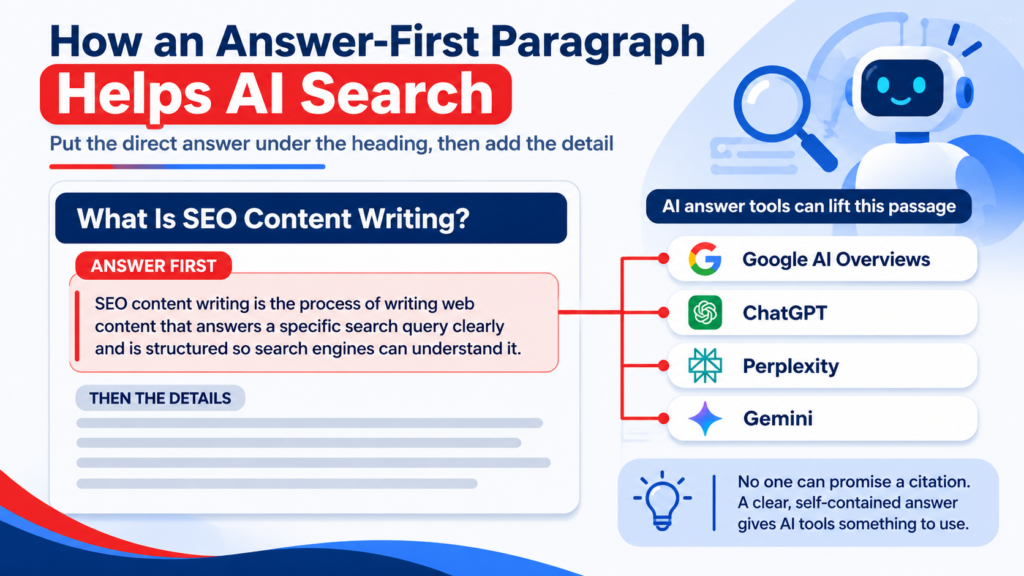
Then answer each question in the first one or two sentences under the heading. Details come after. This helps readers who scan, and it gives search engines and AI tools a clean passage to pull.
Good outlines usually have:
- One H1 that names the topic and includes the main keyword.
- H2s for the main questions.
- H3s only when an H2 truly has parts.
- A short FAQ for small questions that do not deserve their own section.

Step 5: Write for People First
Write the draft the way you would explain the topic to a friend who asked. Short paragraphs, plain words, one idea at a time.
A few habits that make a difference:
- State the answer early. Skip the warm-up paragraph.
- Use examples. A concrete example teaches faster than a definition.
- Cut sentences that only repeat the last one.
- Don’t chase a keyword count. Google has said it looks for helpful, people-first content, and there is no magic number of times to use a phrase. Put the main keyword in the title, the H1, the first 100 words, and maybe one subheading. After that, write normally and related terms will show up on their own.
- Explain jargon the first time you use it.
Read the draft out loud. If a sentence sounds odd spoken, rewrite it.
Step 6: Optimize the On-Page Basics
Once the draft is good, handle the technical details. This takes about twenty minutes.
| Element | What to Do |
|---|---|
| Title Tag | Put the main keyword near the front. Aim for around 60 characters so it does not get cut off. Google sometimes rewrites titles, so make sure the page itself backs up the promise. |
| Meta Description | Write it yourself, about 150 to 160 characters, like a short ad for the page. It does not directly affect ranking, but it affects whether people click. |
| H1 | Use one per page. It should match the title tag’s promise. |
| URL | Keep it short and readable, like /seo-content-writing/. |
| Opening Paragraph | Answer the query and use the main keyword once. |
| Images | Add a short, plain description in the alt text. Describe the image, do not stuff keywords. |
| Internal Links | Link to three to five related pages on your site, using descriptive anchor text. Avoid “click here.” |
| External Links | Link to the original source when you cite a fact, such as Google Search Central. |
Also check that the page can be indexed. A stray “noindex” tag or a blocked page will keep the best article invisible.
Step 7: Publish, Measure, and Update
After publishing, submit the URL in Google Search Console and link to the post from a few existing pages so Google finds it faster.
Give it about three months before judging. Then look at four numbers in Search Console:
- Impressions: Google is showing the page. Low impressions can mean the topic or the intent is off.
- Average position: how competitive you are for your queries.
- Click-through rate: if you rank well and few people click, rewrite the title and description.
- Conversions or next actions, If the post has a goal, such as a signup, monitor its performance and consider applying conversion rate optimization techniques to encourage more visitors to take the desired action.
- .
Update the post when something actually changes: a new tool, a new Google guideline, a better example. Changing the date without changing the content does not help.
SEO Content Writing Tips That Still Work
These are the habits I would keep if every other rule disappeared.
- Search your keyword before you write. The results page is the best brief you can get.
- Answer first, explain second. Put the direct answer under each heading, then add detail.
- Cover the topic, not the keyword. If a reader would reasonably ask a follow-up question, answer it on the page.
- Add something original. A screenshot of your own data, a result from a test, a real before and after. Pages that only repeat other pages give Google no reason to rank them.
- Keep paragraphs short. Two to four sentences works for most web readers, who scan before they read.
- Use headings that say what the section is. Clever headings hide the topic from both readers and search engines.
- Link generously inside your site. Internal links help Google find pages and understand how your topics connect.
- Edit before you publish. Cut the intro, cut the filler, check every fact.
SEO Content Writing Checklist
Use this before you hit publish.
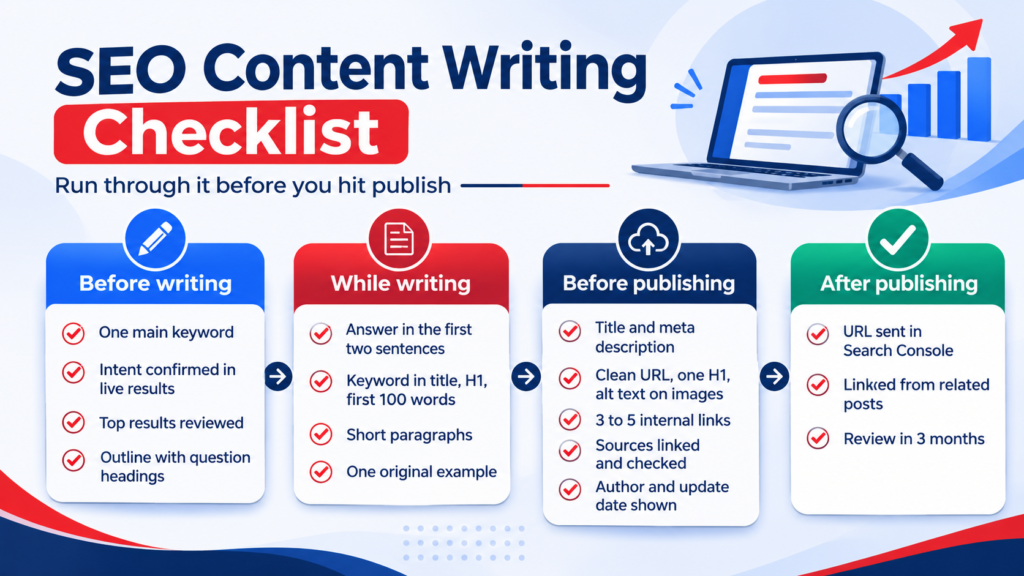
Before writing
- One main keyword chosen, with the search intent confirmed in the live results.
- Top results reviewed, with notes on the format and the gaps.
- Outline written with question-style headings.
While writing
- The answer appears in the first two sentences under each main heading.
- The main keyword is in the title, H1, and first 100 words.
- Paragraphs are short and every example is concrete.
- At least one original element: your own example, data, or screenshot.
Before publishing
- Title tag and meta description written.
- Clean URL, one H1, alt text on images.
- Three to five internal links and links to original sources.
- Author name, bio, and update date visible.
- Facts and links checked.
After publishing
- URL submitted in Google Search Console.
- Calendar reminder to review results in three months.
SEO Content Writing Examples: Before and After
Seeing a weak version next to a better one makes the rules easier to remember. These three examples are written for this guide.
Heading
Before: “Our Approach to Keywords” After: “How to Choose a Keyword for a Blog Post”
The second tells the reader and Google exactly what the section answers.
Opening sentence
Before: “In today’s digital world, content is more important than ever, and businesses need to stay ahead.” After: “To choose a keyword, type your idea into Google and see who ranks. If the top results are all how-to guides, write a how-to guide.”
The first says nothing a reader can use. The second gives them the first step.
Title tag
Before: “Blog Post About SEO | Best SEO Tips | SEO Content | Brand Name” After: “SEO Content Writing: Step-by-Step Guide for Beginners (2026)”
The first repeats the topic and reads like a keyword list. The second has one clear promise and fits in the results page.
Common SEO Content Writing Mistakes
- Writing to a keyword count. It makes the text awkward and adds no ranking benefit.
- Ignoring search intent. A great guide will not rank where Google wants product pages.
- Burying the answer. Readers leave, and the page is harder to pull a snippet from.
- Publishing thin posts. Five hundred words that skim the topic lose to a page that actually covers it.
- Writing one weak page per keyword variant. Combine closely related phrases into one strong page.
- Forgetting internal links. A new post with no links pointing to it can take longer to get found.
- Never updating. Old statistics and dead links make a page less trustworthy.
- Judging rankings too early. Most new posts need weeks or months.
How to Write SEO Content for AI Search and Google AI Overviews
Google’s AI Overviews, ChatGPT, Perplexity, and Gemini all pull information from web pages. Nobody outside those companies can promise a citation, and a “guaranteed trick” is a guess. What you can do is make your page easy to quote and easy to trust. This is often called GEO, short for generative engine optimization, and most of it is good writing.
- Put the answer first. A clear two-sentence answer under each heading is the passage an AI tool is most likely to lift.
- Define terms in one sentence. “X is…” statements are easy to extract.
- Match headings to real questions. Use wording people type into search and into chat tools.
- Keep each paragraph self-contained. A passage should make sense without the paragraphs around it.
- Add information that is not everywhere else. Original examples, data, and experience give an AI system a reason to use your page instead of any other.
- Name sources. Link to where facts come from. It helps readers and shows your work.
- Use consistent terms. If you call it “search intent,” do not switch to three other names halfway down.
- Show who wrote it and when it was updated. Both are trust signals.
- Let the right crawlers in. Make sure the page is indexable and not blocked in robots.txt. Blocking AI crawlers is a choice some sites make, so decide on purpose.
- Keep facts current. Old numbers get dropped quickly.
Can You Use AI to Write SEO Content?
Yes, with care. Google has said it cares about whether content is helpful, not about the tool used to produce it, and it treats content made mainly to manipulate rankings as spam.
AI works well for brainstorming questions, building a rough outline, and tightening a paragraph. It cannot supply your experience, verify facts, or tell you something the other nine results do not. If you use it, the rule is simple: a person checks every claim, adds real examples, and rewrites anything generic before it goes live.
Tools for SEO Content Writing
You do not need many tools. Four cover most of the work:
- Google Search Console (free): your own queries, impressions, clicks, and indexing status.
- Google Trends (free): whether interest in a topic is rising, falling, or seasonal.
- A keyword tool such as Ahrefs or Semrush: search volume and difficulty.
- A readability or grammar checker: catches long sentences and typos.
Topic scoring tools can help as a checklist for missing subtopics. They are risky as a target, because writing to a score tends to produce padded text. For a full comparison, see our guide to SEO content writing tools
FAQs
What is SEO content writing in simple words?
It is writing a page that answers a search query so well that Google has a reason to rank it and a reader has a reason to stay. You research what people search for, check what already ranks, write a clear answer, and set up the title, headings, and links so the page is easy to understand.
How many times should I use a keyword in an article?
There is no correct number. Use the main keyword in the title, the H1, the first 100 words, and perhaps one subheading, then write naturally. Repeating a phrase to hit a count makes the text worse and does not help rankings. Covering the topic fully matters more.
How long should an SEO article be?
As long as it needs to be to answer the question. Check the pages that rank, cover the subtopics they cover, and add what they miss. A simple comparison may need 800 words. A full guide like this one needs more. Padding to reach a number lowers quality.
How do I learn SEO content writing?
Start by writing one post using the steps above and checking the results in Google Search Console. Read Google’s own SEO starter guide, study the top pages for a keyword you care about, and review your numbers every few weeks. Practice on a real site teaches faster than any course.
Is SEO content writing worth it?
It is worth it if you can wait and keep improving. Rankings take time, and results vary by topic and site. The reward is traffic that continues after you publish. It is a poor fit if you need customers this week.
Sources
- Google Search Central: Creating helpful, reliable, people-first content
https://developers.google.com/search/docs/fundamentals/creating-helpful-content
- Google Search Central: SEO Starter Guide
https://developers.google.com/search/docs/fundamentals/seo-starter-guide
- Google Search Central: Influencing your title links in search results
https://developers.google.com/search/docs/appearance/title-link